The challenge is that fixture costs vary sharply by type, material, store scale, and customization level. A basic MDF slatwall panel and a commercial-grade steel system can differ by an order of magnitude — and neither quote includes accessories, installation, or freight until you ask.
This guide breaks down per-square-foot pricing ranges for common fixture types, the factors that drive costs up or down, and how to build a shelving budget that holds up in the real world.
Key Takeaways
- Entry-level slatwall panels run roughly $3–$7 per sq ft (panel only); premium systems reach $25+ per sq ft
- Material and fixture type drive the biggest cost differences — steel and aluminum outlast MDF by a wide margin
- Accessories and installation often double the base panel cost — budget for both from the start
- Small boutiques and pop-ups skew toward entry-level; high-traffic or heavy-merchandise retailers need commercial-grade systems
- Higher upfront investment pays off through longer lifespan and lower total cost of ownership
How Much Do Retail Shelving Fixtures Cost Per Square Foot?
There's no single fixed number. "Per square foot" pricing is calculated based on the wall or floor area a fixture system covers — and that figure shifts depending on fixture type, material, finish, and whether installation is included.
Retailers who misread this end up in one of three situations:
- Underbudgeting, then scrambling when accessories and installation costs surface late
- Choosing the wrong fixture type for their product weight or store format
- Comparing a panel-only quote to an installed-and-accessorized quote and wondering why actual invoices look nothing like vendor estimates
Typical Cost Ranges by Tier
The table below reflects current market pricing based on vendor data. Panel costs are per square foot of coverage. Installation, accessories, and freight are additional.
| Tier | Typical Panel Cost (Per Sq Ft) | What's Included |
|---|---|---|
| Entry-Level | ~$3–$7 | Basic MDF/melamine slatwall, pegboard panels, standard gondola units |
| Mid-Range | ~$7–$15 | Aluminum slatwall, modular gondola, gridwall with accessories |
| Premium | ~$15–$25+ | Commercial steel or heavy-duty aluminum, custom finishes, branded configurations |
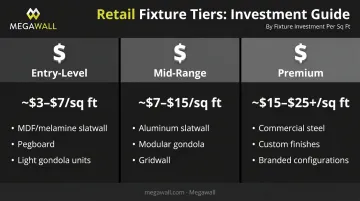
Sources: Store Fixtures Direct (4'x8' panels at $84–$99), Displayarama's 2026 cost breakdown ($7 basic, $25 premium per sq ft)
Each tier serves a different store type and load requirement. Here's what to expect from each.
Entry-Level Setup
Entry-level fixtures suit small boutiques, pop-up shops, and retailers on a tight budget.
Typical inclusions:
- Basic MDF or melamine slatwall panels (4'x8' panels running $84–$99)
- Standard pegboard panels
- Light-gauge gondola units
- Limited finish and accessory options
MDF works for low-traffic, light-merchandise environments, but it doesn't hold up under consistent heavy loads. The panel surface can degrade with regular cleaning or humidity exposure, and that low upfront cost often leads to earlier replacement cycles.
Mid-Range Setup
Mid-range fixtures are well-suited for established independents and small chains that need durability and flexibility.
Typical inclusions:
- Aluminum slatwall panels with multiple spacing options
- Modular gondola units (double-sided starter units run $334–$339)
- Gridwall panels with accessory range
- Standard finishes, some custom sizing
This tier delivers the best balance of cost and performance for most retail formats. Aluminum systems — like Megawall's aluminum slatwall line, which carries LEED certification and uses over 50% recycled content — offer meaningful durability advantages over MDF without the full cost of custom steel.
Premium Setup
Premium fixtures are built for major retailers, high-traffic stores, and formats like sporting goods or hardware where heavy merchandise loads are the norm.
Typical inclusions:
- Commercial-grade steel or heavy-duty aluminum slatwall
- Full custom configurations and branded finishes
- Professional installation
- Integrated trim, corner systems, and signage compatibility
Megawall's steel slatwall systems, for example, hold over 50 lbs per linear foot — a load capacity that standard MDF cannot approach. For stores restocking heavy product daily, that load capacity is a structural necessity, not a style preference.
Key Factors That Affect the Cost of Retail Shelving Fixtures
Pricing is shaped by a combination of technical and operational factors. Understanding these prevents both overpaying and under-specifying.
Fixture Type and Configuration
Different fixture categories carry different cost structures:
- Slatwall panels (wall-mounted) — highest flexibility and merchandising density per linear foot; cost varies significantly by material
- Gondola shelving (freestanding) — priced per unit rather than per sq ft; double-sided units run $334–$784+ depending on size and build
- Gridwall — versatile and moderately priced; panel pricing not as uniformly documented as slatwall
- Pegboard — lowest entry cost; limited load capacity and customization
Double-sided gondola configurations cost more per unit than wall-mounted single-sided setups, but deliver more display surface per square foot of floor space — a real advantage in high-traffic retail layouts where every inch counts.
Material and Build Quality
Long-term cost comes down to one variable more than any other: material choice.
| Material | Cost Profile | Performance |
|---|---|---|
| MDF/Particleboard | Lowest upfront | Lower load capacity; susceptible to warping, moisture, delamination |
| Aluminum | Mid-to-premium | Lightweight, corrosion-resistant, LEED-certifiable; 50+ lbs/linear ft (commercial grade) |
| Steel | Premium | Highest load capacity; no warp or delamination; ideal for heavy merchandise |
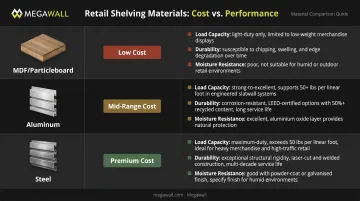
Retailers frequently underestimate how quickly budget MDF systems degrade in high-traffic environments. Metal systems cost more upfront but require less maintenance and no early replacement. Megawall's aluminum systems eliminate formaldehyde off-gassing and dust issues associated with MDF — a real indoor air quality consideration for enclosed retail spaces.
Size, Scale, and Coverage Area
Total linear footage of wall coverage drives overall project cost more than per-unit pricing. A boutique outfitting 200 sq ft of wall space has a very different budget profile than a 10,000 sq ft sporting goods store.
Quantity ordering does reduce per-unit cost. Displays2Go, for example, prices modular slatwall sets at $297.99 for 1–4 sets, dropping to $271.99 for 5–25 sets, roughly an 8.7% savings at volume. For regional or multi-location retailers, bulk purchasing can meaningfully reduce fixture cost per square foot.
Customization and Installation
Off-the-shelf systems cost significantly less than custom-engineered solutions. But custom sizing or branding requirements for unusual store dimensions or flagship locations may justify the premium.
Installation adds real cost, and it's often omitted from initial quotes:
- Professional slatwall installation: $75–$135/hour or $0.25–$3.00/sq ft
- Typical retail installation project: $500–$1,200
- Larger 12'x12' room installation (materials included): $3,000–$4,800
- DIY savings estimate: $300–$600
Wall-mounted slatwall requires anchoring into studs, so professional installation matters. Freestanding fixtures like gondola units or Megawall's H-Frame, L-Frame, T-Frame, and Pinwheel display fixtures are designed for customer assembly — no outside labor required.
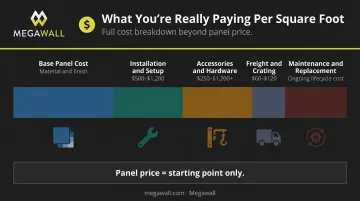
Full Cost Breakdown: What You're Actually Paying Per Square Foot
The panel price is just the starting point. Total cost of ownership includes several components that frequently get omitted in initial budgets.
| Cost Component | Timing | Notes |
|---|---|---|
| Base fixture / panel cost | One-time | What vendors quote; excludes accessories, finishes, installation |
| Installation and setup | One-time | Labor for anchoring, assembly, wall prep; $500–$1,200 typical |
| Accessories and hardware | One-time + periodic | Hooks, brackets, shelf inserts, label holders; typical accessory packages run $250–$1,200+ |
| Freight and crating | One-time | Market average $60–$120 per shipment; some vendors include crating |
| Maintenance and replacement | Recurring | Higher-grade fixtures reduce or eliminate this cost over time |
A Word on Accessories
Accessory hardware — slatwall hooks, shelf brackets, label holders, dividers — is almost always sold separately. Peg hooks alone range from $0.32 to $1.25 each depending on length and material. A fully merchandised wall with high hook density can accumulate accessory costs quickly. Factor accessory costs into your initial budget — a fully stocked wall section can add $250–$800 in hardware before a single product is hung.
Lifespan and Total Cost Considerations
MDF systems warp, delaminate, and degrade over time — particularly under heavy restocking cycles and humidity fluctuations. Megawall's steel and aluminum systems are engineered to eliminate those failure points entirely.
Megawall's steel slatwall is built for lasting display, holding over 50 lbs per linear foot with no risk of warping or delamination through years of seasonal use.
The practical implication: a premium fixture purchased once will almost always be less expensive over a 10–15 year horizon than replacing a budget system two or three times over the same period.
Budget vs. Premium Shelving Fixtures — What's the Real Difference?
The gap between a ~$7/sq ft entry system and a ~$25/sq ft premium system isn't just aesthetics. The real differences show up in durability, merchandising density, and design capability.
Durability and Load Capacity
Budget MDF slatwall and light-gauge gondolas have lower weight limits and degrade faster under daily restocking. Commercial-grade steel or aluminum slatwall maintains structural integrity under consistent load — Megawall's steel systems hold over 50 lbs per linear foot regardless of configuration or finish choice. Aluminum panels with inserts can hold up to 100 lbs per horizontal line .
For hardware stores, sporting goods, or any retailer with heavy merchandise, load capacity isn't optional — it's a safety and operations requirement.
Merchandising Density and Revenue per Square Foot
Tighter slat spacing means more accessory attachment points and more SKUs per linear foot. Megawall manufactures slat spacing from 1 inch to 3 inches on center, with 1-inch spacing offering maximum product density for smaller items. A 2022 study published in the Journal of Retailing found that optimized in-store display allocation produced an average 11.15% increase in store revenue — and fixtures that enable finer accessory placement are part of what makes optimization possible.
Designer and Premium Aesthetic Options
Premium tier also includes purpose-built designer systems. Megawall's V-Wall embeds into 5/8" drywall and accepts floating glass or acrylic shelves for a gallery-like presentation. The WaveWall uses wave-contoured aluminum profiles with hidden fasteners for a clean wall profile with no visible mounting hardware. Both sit above standard slatwall in cost and visual impact. They're the right fit for boutiques or flagship locations where store atmosphere directly drives conversion.
How to Estimate the Right Shelving Budget — And What Most Retailers Miss
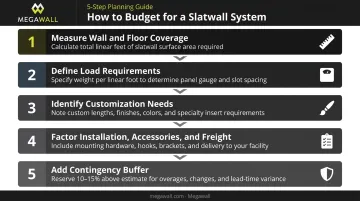
Start with store footprint and fixture requirements, not a price-per-unit search. Work through these steps in order:
- Measure total wall and floor fixture coverage — linear feet of wall space plus floor fixture count
- Define product weight and load requirements — determines minimum material grade
- Identify customization and branding requirements — custom colors, lengths, or configurations add cost and lead time
- Factor in installation, accessories, and freight — these components can add substantially to the base panel cost
- Add a contingency buffer — hidden costs are common in fixture projects; build buffer into your plan from the start
Common Budget Mistakes
- Quoting only the panel price. Installation, accessories, and freight can add 20–40% or more to the per-square-foot total. Never compare vendor quotes without confirming what each includes.
- Choosing the cheapest fixture type without checking load capacity. Fixtures that bow or tip under product weight create safety hazards and replacement costs that far exceed the original savings.
- Over-specifying premium fixtures in low-traffic zones. Back-of-store areas and low-traffic sections don't need the same fixture grade as perimeter walls and end caps. Match fixture tier to actual zone demand.
Getting accurate quotes requires a supplier who can account for all three variables: layout, load, and finish. Megawall builds custom configurations in-house — laser cutting, press brakes, roll forming, and MIG/TIG welding — so you get direct pricing on steel, aluminum, and designer lines without distributor markups or third-party lead times.
Frequently Asked Questions
Frequently Asked Questions
How much do retail store shelving fixtures cost per square foot?
Entry-level slatwall panels start around $3–$7 per sq ft for basic MDF or melamine; premium commercial-grade aluminum or steel systems run $15–$25+ per sq ft. Panel pricing rarely includes installation labor ($0.25–$3.00/sq ft) or accessories ($250–$1,200+ per display) — factor those in separately when budgeting.
What is retail shelving called?
The main categories are slatwall, gondola shelving, gridwall, and pegboard. "Store fixtures" and "retail display systems" are the umbrella terms used across the industry. Manufacturers and distributors use these terms interchangeably, so searching either will surface the same product types.
What is the difference between slatwall and gondola shelving?
Slatwall is a wall-mounted panel system with horizontal grooves that accept accessories like hooks, brackets, and shelves — best for perimeter wall merchandising. Gondola shelving is a freestanding, double-sided aisle unit used to create product aisles on the sales floor.
How long do retail shelving fixtures typically last?
MDF and particleboard systems typically last 3–7 years under regular retail use before warping or delamination becomes an issue. Commercial-grade steel and aluminum systems are built for 15+ years of service with no degradation — ask your manufacturer for specific warranty terms before purchasing.
Is aluminum or steel slatwall better for retail stores?
Steel offers the highest load capacity — critical for hardware, sporting goods, or heavy merchandise displays. Aluminum is lighter, corrosion-resistant, and available in LEED-certified options made from 50%+ recycled content, making it a strong choice for stores prioritizing sustainability alongside durability. Megawall's aluminum systems meet both criteria.
What are the hidden costs of retail shelving fixtures?
The most commonly overlooked costs include:
- Accessory hardware (hooks, brackets, shelf inserts)
- Professional installation labor and freight/crating fees
- Replacement costs when budget fixtures degrade ahead of schedule
Always request an all-in quote before comparing options.