That gap comes down to fixtures. POPAI's 2014 Mass Merchant Shopper Engagement Study found that 82% of purchase decisions are made in-store — meaning the physical environment, including your fixtures, is actively influencing most sales.
This guide covers the main types of retail display fixtures, what separates effective displays from ineffective ones, how to choose the right materials, and layout principles that turn foot traffic into revenue.
Key Takeaways
- Retail display fixtures are active sales tools — they guide customer flow, highlight key products, and reinforce brand identity.
- Match your fixture type to your product category: wall systems maximize floor space, end caps capture impulse buys.
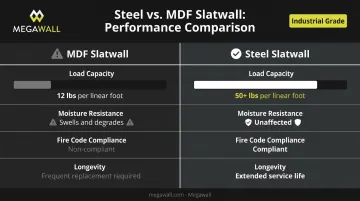
- Metal outperforms MDF on load capacity, durability, moisture resistance, and fire code compliance.
- Modular fixture systems let you reset for seasons or inventory changes without replacing existing hardware.
Types of Retail Display Fixtures Every Store Needs
No single fixture type works for every store. Effective retailers combine fixture categories — each serving a distinct role in the customer journey, from the moment someone enters to the final moment at checkout.
Wall Display Systems and Slatwall
Wall-mounted displays convert underused wall space into vertical merchandising real estate. That frees up floor space for customer movement, which matters more than it might seem — a 2026 peer-reviewed study found that removing mid-aisle fixtures increased sales by 0.50 percentage points, an 11.5% uplift, with shoppers making 7 times more product-touch events in low-crowding environments.
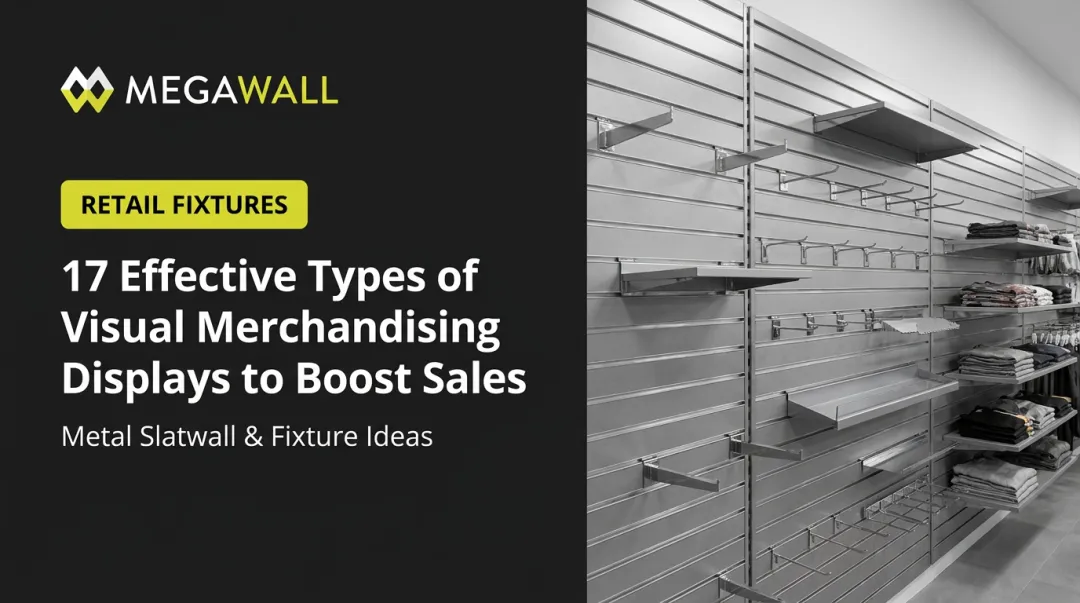
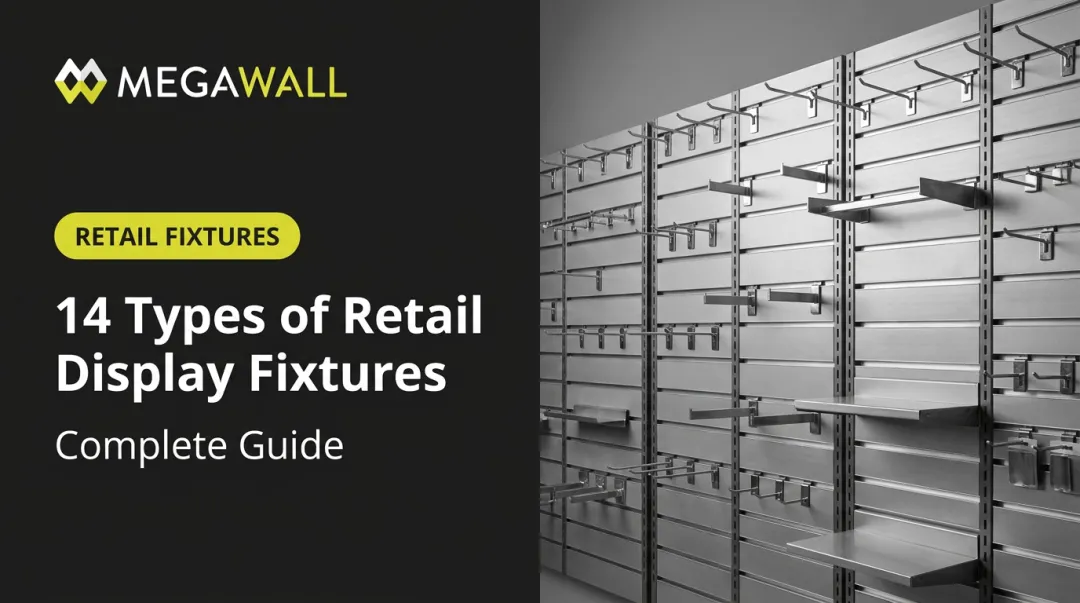
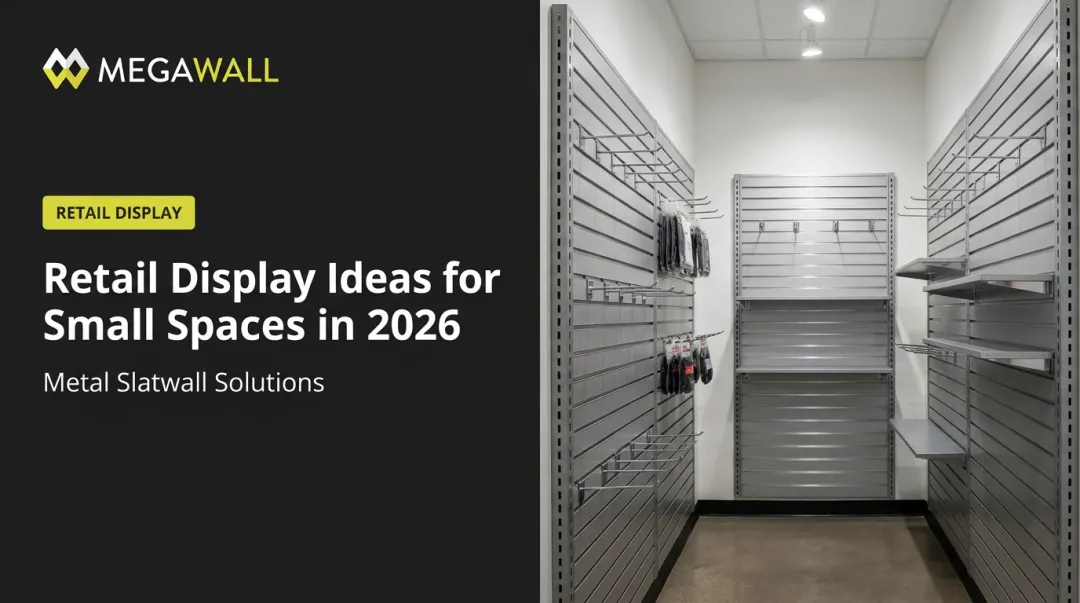
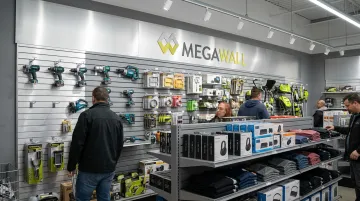
Slatwall is the most versatile wall display format. A single panel accepts hooks, shelves, baskets, and bins — and can be reconfigured quickly for seasonal shifts or promotional campaigns without tools or major labor.
Material matters here. Standard MDF slatwall panels sag under load, absorb moisture, and degrade visibly in high-traffic environments. Megawall's steel slatwall holds over 50 lbs per linear foot and meets fire codes — something MDF panels often can't claim in commercial retail environments.
For retailers prioritizing aesthetics alongside performance, Megawall's patented aluminum slatwall features a 1-inch-on-center design with a concealed fastener system that creates flush, uninterrupted surfaces across sections up to 8 feet wide. The result is a clean, hardware-free backdrop that works equally well in sporting goods stores and specialty retail environments.
Freestanding and Floor Displays
Gondola shelving and freestanding units form the backbone of aisle organization. Double-sided gondolas maximize product capacity while creating navigable store paths. Freestanding floor displays — available in H-Frame, L-Frame, T-Frame, and Pinwheel configurations — offer placement flexibility for promotional or seasonal items in high-traffic zones.
Key options for different situations:
- H-Frame — four-sided display on wheels, ideal for repositioning during seasonal resets
- L-Frame — creates a focal point and guides traffic toward specific product categories
- T-Frame — two-sided unit combining wall-unit strength with freestanding flexibility
- Pinwheel — compact four-sided display for tight spaces or end-cap positions
Dump bins and pallet displays work well for clearance or high-volume promotional items. They require minimal staff involvement and naturally encourage impulse grabs from passing shoppers.
End Cap, Counter, and POP Displays
Beyond aisle and floor placement, where you position a display within the store has an outsized effect on performance. End caps are among the highest-performing real estate in any retail store.
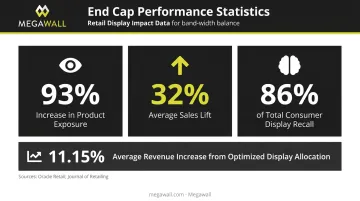
Oracle Retail research found that being on an endcap delivers roughly a 93% increase in product exposure and an average 32% sales lift in grocery outer-aisle placement.
A 2022 Journal of Retailing study reinforced this: floor stands and end cap displays account for 86% of total consumer recall for in-store displays, and optimizing display allocation across store locations produces an average 11.15% revenue increase.
Point-of-purchase counter displays near checkout are the last opportunity to drive impulse sales. They work best for small, grab-and-go items — accessories, snacks, add-ons — that complement a primary purchase.
Fixture shape at checkout also matters: separate research published in Production and Operations Management found that tower-shaped fixtures outperform conventional flat displays for driving purchase intent at point-of-sale.
What Makes a Retail Display Fixture Effective
Effective fixtures share five traits: durability, flexibility, brand alignment, smart layout integration, and security. Missing even one can undercut an otherwise well-merchandised store.
Durability
Fixtures in high-traffic retail take constant abuse — from customers, restocking crews, and cleaning. A wobbly shelf or chipped display communicates poor quality to shoppers even before they evaluate the product sitting on it. Research confirms this: store environment cues directly affect perceived merchandise value and patronage intentions.
Metal fixtures — specifically steel and aluminum — resist warping, delamination, and moisture damage that consistently degrade MDF panels.
The Composite Panel Association's 2023 technical bulletin documented that MDF and particleboard gain permanent thickness swell from humidity exposure — a relative humidity shift from 40% to 85% produces measurable linear expansion that doesn't fully reverse after re-drying. In a retail environment with HVAC cycling and variable conditions, that's a real problem.
Flexibility and Modularity
Modular displays let retailers adapt layouts for seasonal resets, new product launches, and changing inventory without scrapping existing fixtures. This matters most for stores cycling through seasonal merchandise — sporting goods, hardware, general merchandise — where the product mix looks completely different in October versus April.
Megawall's slatwall systems are engineered specifically for this. Multiple slat spacing options (1", 1-3/8", 1-1/2", 2", and 3" on center for aluminum) allow retailers to optimize display spacing based on product dimensions, and the modular freestanding fixtures are built to be repositioned as floor plans change.
Brand Alignment and Security
Fixtures are a physical extension of brand identity. Their finish, color, and form should feel intentional, not generic. Off-the-shelf solutions rarely match brand aesthetics — purpose-built or customized fixtures create store environments where every fixture feels like it belongs.
Megawall offers extensive finish options: aluminum systems in anodized, raw mill, white, and black, with custom powder-coat available; steel systems in a broader palette including Dove Gray, Platinum, and Candy Apple finishes. For premium retail environments, the V-Wall and WaveWall designer lines deliver architectural-grade aesthetics with concealed fasteners and optional floating shelf capability.
On security: well-designed fixtures protect high-value items without creating friction for genuine shoppers. Locking cases and weight-sensitive designs work best when integrated into the original display design — retrofitted security hardware rarely looks intentional and often damages the customer experience.
How to Choose the Right Fixture Material
Fixture material is a long-term investment. The upfront price difference between MDF and quality metal is typically recovered through reduced maintenance, longer service life, and better in-store performance.
MDF vs. Metal: What the Data Shows
| Factor | MDF Slatwall | Metal Slatwall |
|---|---|---|
| Load capacity (unreinforced) | ~12 lbs per bracket | 50+ lbs per linear foot |
| Moisture resistance | Low — swells permanently | High — unaffected |
| Fire code compliance | Varies by jurisdiction; often non-compliant | Meets commercial fire codes |
| Maintenance | Chips, delaminates, shows wear | Easy to clean, resists wear |
| Long-term cost | Higher (frequent replacement) | Lower (extended service life) |
American Retail Supply testing data shows unreinforced MDF slatwall holds approximately 12 lbs per bracket at 12 inches from the wall, while reinforced versions with aluminum inserts reach around 50 lbs per bracket. Megawall's steel and aluminum systems both hold over 50 lbs per linear foot as a standard specification, placing them in a fundamentally different load class.
Sustainability: Aluminum with Recycled Content
For retailers with sustainability commitments or stores pursuing LEED certification, Megawall's aluminum slatwall is made from over 50% recycled content and is LEED-certified. USGBC's LEED v4 Interior Design and Construction guide includes material credits for recycled content and sourcing — fixture material choices can contribute directly to certification targets.
Industry data from USGBC's LEED in Motion: Retail report found that the vast majority of retail projects claimed recycled-content credits, and major retailers like Nike have incorporated 100% FSC-certified wood and significant recycled content in store builds. Choosing fixtures with documented recycled content supports both compliance goals and brand positioning.
Custom vs. Off-the-Shelf
- Custom solutions are designed to exact store dimensions, product mix, and brand standards. Best suited for multi-location chains or flagship stores where visual consistency across locations matters.
- Off-the-shelf options ship faster and carry lower upfront cost. A practical fit for single-location retailers with standard footprints and tight timelines.
Megawall offers both. Standard configurations ship in steel or aluminum slatwall across multiple spacing options, while the in-house fabrication facility — 45,000 sq ft with fiber laser cutting, press brakes, and MIG/TIG welding — handles full custom fabrication for retailers with specific requirements.
Best Practices for Retail Display Layout
Choosing the Right Store Layout Format
Your layout format determines how customers move through the store and which fixtures belong where:
- Grid: parallel aisles with predictable category organization. Best for hardware, grocery, and high-SKU environments
- Loop/Racetrack: oval path that exposes shoppers to more inventory. Works well for mid-size specialty stores
- Herringbone: central aisle with angled offshoots, designed for long, narrow spaces
- Free-flow: flexible and experiential. Best suited to boutiques and lifestyle retail
Fixture selection should reinforce your chosen layout. Grid formats pair naturally with gondola shelving and wall systems, while loop formats depend on strong end cap positioning. Free-flow environments work best with freestanding modular displays that can shift as the layout evolves.
Strategic Product Placement
- High-demand items placed toward the back draw shoppers through more of the store
- Impulse buys and seasonal items belong near checkout and on end caps
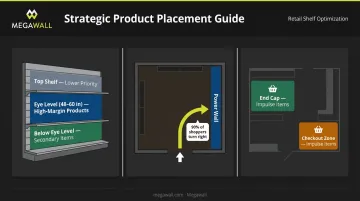
- Eye-level placement is reserved for high-margin products — research shows center/middle shelf placement generates significantly more purchases than high or low positions
- The power wall (the right-side wall near the entrance) works best for new arrivals or high-impact displays, since approximately 90% of shoppers turn right after entering
Layout Mistakes That Hurt Conversion
- Cluttered aisles that create spatial crowding — studies consistently show crowding suppresses sales by reducing dwell time and shopper comfort
- Missing decompression zone at the store entrance (shoppers need 5-10 feet to transition before they engage with merchandise)
- Poor lighting in key merchandise areas
- Shoppable depth exceeding 36 inches: the ADA minimum clear aisle width is 36 inches, and keeping merchandise within that depth improves both accessibility and shopper reach
Keeping Your Displays Fresh and Maximizing ROI
Refresh Cadence
Refresh displays every 2–4 weeks to maintain interest for repeat visitors. This doesn't require a full overhaul — rotating products, updating signage, or reorganizing a feature section achieves the effect. Modular and slatwall-based systems make this faster because accessories can be repositioned without tools.
Larger seasonal resets — back-to-school, holiday, clearance — should be planned against the retail calendar. Megawall's freestanding fixtures are built to highlight seasonal inventory and expand regular assortments, with modular configurations that allow floor plan changes without buying new hardware.
Planograms and Sales Data
Display decisions should be driven by data, not intuition. Planograms ensure consistent execution across multiple store locations and prevent high-margin products from being buried on lower shelves.
The 2022 Journal of Retailing display-allocation study found that optimized display allocation produces an average 11.15% revenue increase — which represents real dollars when applied at scale. When building or reviewing a planogram, a few principles consistently move the needle:
- Place high-margin products at eye level (roughly 48–60 inches off the floor)
- Align facings and product groupings with actual sales velocity data
- Revisit shelf allocations after each seasonal reset, not just annually
Megawall pairs retail display engineering and layout consulting with its fixture products, supporting retailers through the planning process as well as the hardware selection.
Frequently Asked Questions
What is the difference between steel and aluminum slatwall?
Steel slatwall offers high load capacity and is positioned for heavy-duty or permanent installations, with a broader range of premium color finishes. Aluminum slatwall is lighter, corrosion-resistant, available with 50%+ recycled content for LEED projects, and offers more slat spacing options for flexible product display. Both significantly outperform MDF alternatives.
How do I choose the right retail display fixture for my store?
The choice depends on store format, product category, available wall versus floor space, and whether flexibility or structure is the priority. Slatwall and modular systems work well for stores with changing inventory; gondola shelving and fixed cases suit high-SKU environments with stable assortments.
How much weight can a slatwall fixture hold?
It varies by material. Metal slatwall — including Megawall's steel and aluminum systems — holds over 50 lbs per linear foot. Unreinforced MDF slatwall holds roughly 12 lbs per bracket; reinforced MDF with aluminum inserts improves this but still introduces moisture and structural vulnerabilities that metal avoids entirely.
What is the best fixture for maximizing wall space in a retail store?
Slatwall systems are the most versatile wall display solution. They convert flat wall space into configurable merchandising real estate and accept a wide range of accessories — hooks, shelves, baskets — that can be changed as inventory or seasons shift. Hidden fastener systems like Megawall's create seamless 8-foot sections without visible hardware.
How often should retail display fixtures be updated or refreshed?
Every 2–4 weeks for minor rotations, with larger seasonal resets aligned to key retail periods. Modular fixture systems make updates faster and more cost-effective because accessories reposition without tools and freestanding units move without disrupting the broader store layout.
Are metal display fixtures worth the higher upfront cost compared to MDF?
Yes. Metal fixtures last longer, hold more weight, resist moisture damage, are easier to clean, and meet commercial fire codes that MDF may not satisfy. The higher upfront cost is typically recovered through reduced replacement frequency and lower maintenance labor, making the total cost of ownership lower over a typical fixture lifespan.