 Services](https://file-host.link/website/megawall-3eoa3o/assets/blog-images/2b7872f6-843d-407f-8de1-23136d64048b/1781608897496209_d6d782c68e2c4d9291ee4849eef8de5e/360.webp)
The word "custom" still makes some buyers flinch at the price tag. But that reaction usually fades once the total cost of ownership is on the table — fewer replacements, lower maintenance, no rework from parts that almost fit. This article breaks down exactly where those advantages come from.
Key Takeaways
- Custom metal fabrication produces parts built to exact specifications, eliminating the compromises that come with standard catalog components.
- The advantages covered here range from precision fit and design freedom to durability, sustainability, and fire compliance — across the full fabrication lifecycle.
- In retail environments, custom metal fixtures directly affect load capacity, visual presentation, and how long a system holds up under daily use.
- Treating custom fabrication as a long-term partnership consistently delivers more value than defaulting to prefabricated alternatives.
What Is Custom Metal Fabrication?
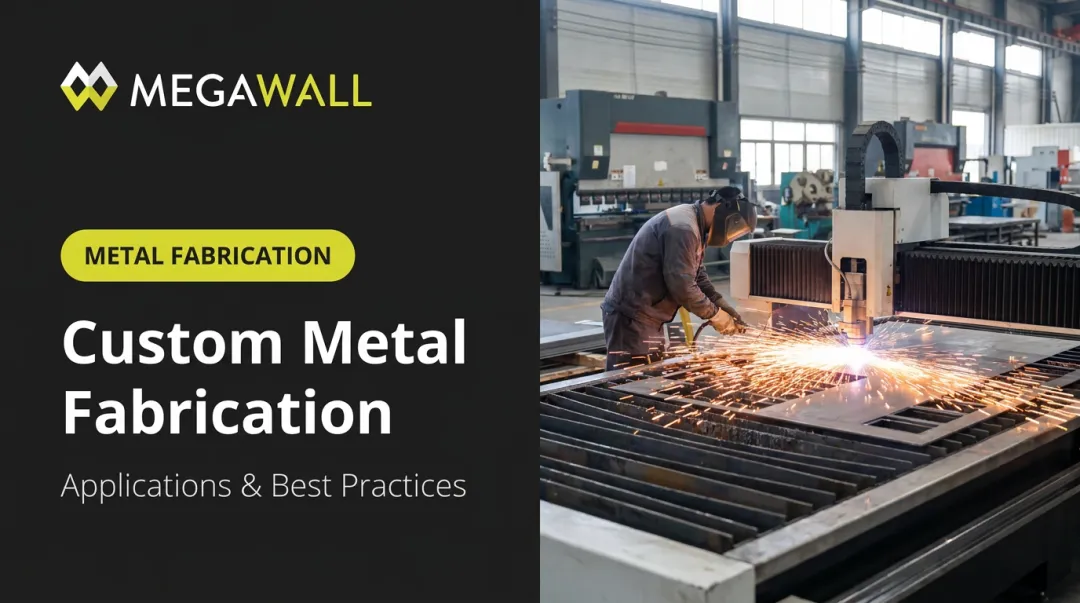
Custom metal fabrication is the process of designing and producing metal parts, components, or systems to meet the exact specifications of a particular application. It uses techniques including cutting, forming, welding, machining, and finishing — all applied to the precise geometry, material, and tolerance requirements of a specific use case, not a generic catalog spec.
It applies across industries — retail display systems, construction, automotive, medical, aerospace, and industrial manufacturing — anywhere standard components fall short of what the application actually demands.
That gap between "standard" and "what you actually need" is where the distinction gets practical:
- Custom fabrication starts with your requirement and builds the part around it
- Standard fabrication starts with an existing part and asks you to adapt around it
For most high-performance applications, the first approach is the only one that produces a component that fits, performs, and lasts.
Top 10 Advantages of Custom Metal Fabrication Services
Each of the following advantages is grounded in operational outcomes — cost, quality, longevity, efficiency, and strategic value.
Advantage 1: Precision Fit and Exact Specifications
Standard parts are designed to satisfy a broad range of applications. That means tolerances wide enough to work in most scenarios — but not necessarily yours. Custom metal fabrication eliminates that compromise. Every dimension, thickness, and tolerance is engineered for the specific application.
Fabricators use CNC machining, laser cutting, and press brake forming to hit exact dimensional requirements. Megawall's facility, for example, operates an HK PS3015 3000W fiber laser with Dynamic Motion Control and a high-stiffness main frame — equipment designed to minimize vibration and maintain consistent accuracy across production runs.
The KPIs this directly affects:
- Installation time (parts fit without modification)
- Error rates during assembly
- Material waste from incorrectly sized components
- Rework costs from post-delivery adjustments
That last point is significant. Research from PlanGrid and FMI found rework costs at approximately 5% of overall U.S. construction costs — roughly $65.2 billion in 2018 — with poor data and miscommunication driving nearly half of those incidents. Precision-fabricated parts reduce that exposure from the start.
In complex assemblies, one misaligned component can cascade into system-level failures. Catching a dimensional issue during fabrication review costs minutes; catching it on a job site costs days.
Advantage 2: Superior Durability and Structural Strength
Custom-fabricated metal parts are engineered for the specific loads, stresses, and environmental conditions of their intended use — not for a generalized application that may or may not resemble yours.
The practical difference in load capacity is substantial. Heavy-duty metal gondola shelving is rated for 500 lbs per shelf and up to 1,250 lbs for a five-shelf unit. Unsupported MDF slatwall, by comparison, typically supports 10–15 lbs per bracket — and MDF vendors often decline to warranty specific weights because results vary by installation.
Megawall's custom steel slatwall is engineered to hold over 50 lbs per linear foot. That's not a theoretical figure — it's a specification built into the product design through heavy-gauge steel, formed and welded construction. The result is a display system that resists warping, delamination, and physical damage that MDF develops over time in high-traffic retail environments.
For retailers, this translates directly: fewer replacement cycles, lower maintenance costs, and a display system that looks and performs the same in year three as it did in year one.
Advantage 3: Higher Long-Term ROI and Cost Efficiency
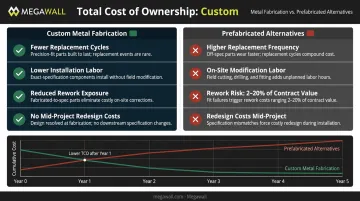
The upfront cost of custom metal fabrication is typically higher than prefabricated alternatives. Most buyers stop at that number. Total cost of ownership tells a different story.
What actually determines cost efficiency is total cost of ownership — and that calculation looks very different once you account for:
- Fewer replacement cycles — custom parts last longer because they're built for the actual operating conditions
- Lower installation labor — parts that fit on the first attempt eliminate modification time on-site
- Reduced rework exposure — the Construction Industry Institute documents rework at 2%–20% of a project's contract value, a range that precision fabrication compresses significantly
- No mid-project redesign costs — when a standard part fails to perform, the redesign cost typically exceeds the original savings
In retail specifically, display systems that hold up under heavy daily use and resist visual degradation deliver a measurably higher return than cheaper alternatives replaced every two to three seasons. A custom steel or aluminum slatwall system that serves a retailer for a decade doesn't just save on replacement costs — it eliminates the disruption, labor, and downtime of recurring fixture refresh cycles.
Advantage 4: Complete Design Freedom and Innovation
Working within catalog dimensions means working within constraints someone else set. Custom metal fabrication removes that ceiling entirely — engineers and designers can create proprietary configurations, patented geometries, and components that competitors cannot replicate from a distributor's stock.
Megawall's history illustrates this directly. In the late 1980s, the company developed the first wall display system with a patented concealed fastener — a design innovation that solved a real problem. Traditional slatwall systems had visible screws and fastening hardware that cluttered the visual field of a display wall and competed with the merchandise for attention.
The hidden fastener system changed that. It enabled seamless, uninterrupted display panels extending up to eight feet without visible hardware — giving retailers a clean backdrop that put products front and center. That design was only possible through custom metal fabrication, and it created a defensible market position that generic off-the-shelf systems couldn't replicate.
Megawall has since extended that innovation into multiple patented aluminum slatwall configurations, including the V-Wall system. Each represents a product category with no off-the-shelf equivalent — IP that competitors cannot source from a distributor.
Advantage 5: Intelligent Material Selection
Off-the-shelf components come in whatever material the manufacturer chose. Custom fabrication lets you choose the material based on what the application actually requires.
That decision has significant downstream consequences:
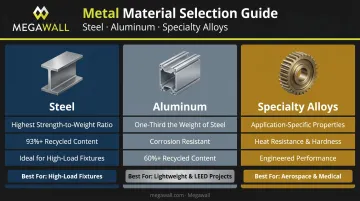
| Material | Primary Strengths | Best-Fit Applications |
|---|---|---|
| Steel | Highest strength-to-weight ratio, 93%+ recycled content in structural grades | High-load fixtures, maximum durability environments |
| Aluminum | One-third the weight of steel, corrosion resistant, 60%+ recycled content | Lightweight displays, humid environments, LEED projects |
| Specialty alloys | Application-specific properties (heat resistance, hardness) | Aerospace, medical, industrial equipment |
For retail display specifically, Megawall uses this distinction deliberately. Steel slatwall is the choice for maximum load capacity and long-term structural performance. Aluminum slatwall — made from over 50% recycled content — is the recommendation when retailers need lighter panels, corrosion resistance, or LEED compliance for a commercial interior project.
Neither material is categorically better. The right choice depends on load requirements, finish preferences, environmental exposure, and regulatory requirements. Custom fabrication makes that choice possible.
Advantage 6: Reduction of Material Waste and Rework
Experienced custom metal fabricators optimize cutting plans, nesting sequences, and material usage before production begins. SME research shows typical nesting yields of 60%–90%, with advanced nesting software reducing programming time by 50% or more and improving material yields by 2%–4% or higher per run.
Standard parts purchasing can't offer this. Buyers absorb the waste built into fixed sheet sizes and generic cuts — and then absorb additional waste when parts don't fit correctly and need to be modified, discarded, or replaced.
Custom fabrication eliminates waste on both sides:
- Material waste is minimized through optimized cutting plans
- Labor waste is eliminated by producing parts that don't require modification after delivery
Coil-fed laser systems take this further by cutting to custom sheet lengths, removing excessively large web sections that standard fixed-size sheets create automatically.
Advantage 7: Seamless Compatibility with Existing Systems
New components don't exist in isolation. They connect to existing infrastructure — and when dimensional specs, load ratings, or connection points don't align, the installation cost climbs fast.
Custom fabrication ensures every connection point is engineered to match what's already in place. Megawall's NuPanel Gondola Retrofit System is a practical example. It uses a Panel-Mod Clip system designed specifically for standard slotted gondola uprights, dropping into existing 36" or 48" gondola structures without requiring structural modification. The gondola uprights remain accessible after installation, so retailers can add shelving, headers, or inserts without tearing anything out.
This matters most in two scenarios:
- Legacy system expansions — when new components need to match existing hardware that no longer has a standard equivalent
- Proprietary infrastructure — when the existing system has no off-the-shelf compatible counterpart
In both cases, retrofitting with custom-fabricated components preserves the existing infrastructure investment rather than writing it off.
Advantage 8: Sustainability and Environmental Compliance
Custom metal fabrication supports sustainability goals in ways that standard fixtures typically cannot, for two reasons: material selection and production optimization.
On the material side, both steel and aluminum are highly recyclable. Domestic structural steel averages 93% recycled content. Recycled aluminum accounts for more than 80% of U.S. aluminum production and uses approximately 5% of the energy required for primary production.
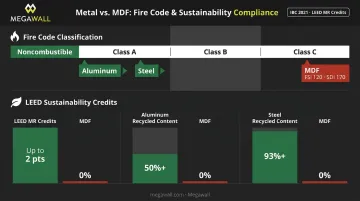
Megawall's aluminum slatwall is manufactured from over 50% recycled content and carries LEED certification. For commercial retailers and facility managers pursuing LEED Interior Design + Construction (ID+C) credits, this matters concretely. LEED v4.1's MR Sourcing of Raw Materials credit is worth up to 2 points, with recycled-content materials valued at 100% of their cost toward the required thresholds.
As of March 2022, nearly 10,000 stores and retail facilities had earned LEED certification globally. For retailers pursuing green building requirements on new buildouts or store remodels, specifying LEED-certified fixtures is one of the more straightforward paths to contributing toward that scorecard — and it requires materials documentation that only a custom fabricator can supply.
Advantage 9: Fire Code Compliance and Safety Standards
Metal is noncombustible. MDF is not.
Under IBC 2021 interior finish classifications, materials are rated Class A (Flame Spread Index 0–25), Class B (26–75), or Class C (76–200). Standard 3/4" MDF panels carry an FSI of 120 and SDI of 170 — placing them in Class C. Aluminum is classified as noncombustible per ASTM E136, and steel is identified by NFPA as a noncombustible construction material.
Both Megawall steel and aluminum slatwall systems meet commercial fire codes — a compliance standard that applies regardless of jurisdiction for mercantile occupancies under IBC Table 803.13. In jurisdictions with stricter Class A requirements, MDF simply does not qualify. Metal does.
For retailers planning commercial installations — particularly in multi-tenant buildings, shopping centers, or facilities subject to enhanced fire safety review — fire code compliance is not a checkbox. It's a prerequisite that determines whether a fixture system can be legally installed at all. Specifying metal from the start removes that compliance uncertainty before installation begins.
Advantage 10: Collaborative Oversight from Design to Delivery
When you order from a catalog, the product is already designed. Your only input is quantity and shipping address. Custom metal fabrication works differently — clients have direct input at each stage, from material selection and design through fabrication, quality inspection, and delivery.
Megawall operates an in-house design and engineering team alongside its fabrication floor. The company's stated commitment is to partner with customers through every stage of the process — problem-solving to ensure products are displayed correctly and perform as required. That team includes 25+ employees with an average tenure of 12.5 years, meaning the people advising on design decisions have seen how those decisions perform in the field.
The practical value: problems are caught and corrected during design review, not after installation. Material substitutions can be evaluated before production. Dimensional adjustments can be made before a single piece of steel is cut.
That level of oversight isn't available with prefabricated purchasing. The gap shows up in costly field adjustments, delayed installations, and fixtures that never quite perform as specified.
What Happens When Businesses Skip Custom Metal Fabrication
The most common consequences of defaulting to prefabricated components:
- Poor dimensional fit requiring costly on-site modification — a problem that compounds when the modified part still doesn't perform as needed
- Accelerated wear from materials not specified for the actual operating conditions
- Repeated replacement cycles that eliminate any initial cost savings within two to three years
In retail environments, standard display fixtures not engineered for load capacity bow under heavy merchandise, corrode in high-humidity areas, or degrade visually — affecting how products are presented at the point of decision.
The stakes multiply at scale. Walmart's remodel programs show how consequential fixture decisions become: the company committed more than $500 million in upgrades across 117 stores in 2023, with plans to remodel 650 stores across 47 states.
At that volume, fixture inconsistency is a brand consistency problem. Custom-fabricated systems with documented specifications replicate identically across hundreds of locations — prefabricated components with variable tolerances don't provide that reliability.
How to Get the Most Value from Custom Metal Fabrication
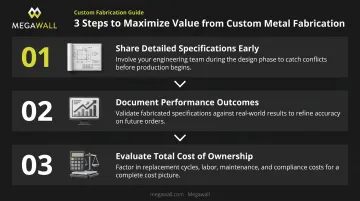
Custom metal fabrication delivers its full value when treated as a partnership, not a transaction. Retailers who approach it that way consistently get better outcomes — tighter specs, longer service life, and lower total cost. Three practices make the biggest difference:
Share detailed specifications early : Involve the fabricator's engineering team during the design phase, not after designs are finalized. Early involvement catches dimensional conflicts and material mismatches before they become production problems.
Document performance outcomes after installation — validate that fabricated specifications matched real-world demands. Use that data to refine future orders, tighten tolerances, and reduce lead times on reorders.
Evaluate total cost of ownership, not unit price. Factor in replacement cycles, installation labor, maintenance requirements, and compliance costs. When those figures are on the table, custom fabrication consistently outperforms off-the-shelf alternatives on a per-year basis.
For retailers especially, this long-term view matters. A display system spec'd correctly from the start — right gauge, right finish, right load rating — stays in service longer, requires fewer replacements, and keeps your floor looking intentional rather than improvised.
Conclusion
The advantages of custom metal fabrication — precision fit, structural durability, long-term cost efficiency, design freedom, sustainability compliance, and fire code qualification — compound over time. They show up in measurable outcomes: lower maintenance costs, fewer replacements, regulatory compliance, and display systems that perform exactly as designed years after installation.
Retailers that treat custom fabrication as a strategic partnership — working with an experienced manufacturer rather than defaulting to off-the-shelf components — consistently see better long-term results. Megawall has spent 21+ years helping major North American retailers build display systems that hold up, stay compliant, and keep performing season after season. The upfront investment is higher than standard components. The return, measured in reduced replacements and consistent merchandising performance, reflects that difference.
Frequently Asked Questions
What are the advantages of metal fabrication?
Custom metal fabrication offers structural strength, precise dimensional fit, longer service life, design flexibility, and the ability to meet specific regulatory or performance requirements — advantages that matter most in high-load, high-traffic, or compliance-sensitive environments where standard prefabricated components fall short.
What do custom metal fabricators do?
Custom metal fabricators design, cut, form, weld, and finish metal components to a client's exact specifications, covering everything from engineering consultation and material selection through production, quality inspection, and delivery. Full-service fabricators like Megawall handle this entire process in-house.
Is custom metal fabrication more expensive upfront than standard options?
Custom fabrication carries a higher upfront cost than prefabricated alternatives. Total cost of ownership is usually lower, though, due to longer product life, fewer replacements, reduced installation rework, and better performance alignment across the product's service life.
What metals are commonly used in custom fabrication for retail display systems?
Steel and aluminum are the most common. Steel is the choice for maximum load capacity and long-term structural performance. Aluminum is preferred for lightweight applications, corrosion resistance, and sustainability-focused projects — including LEED-compliant installations using materials with high recycled content.
How does custom metal fabrication support sustainability goals?
Custom fabrication supports sustainability through recycled-content material selection, optimized production that minimizes scrap, and the ability to specify LEED-certifiable products. Megawall's aluminum slatwall, for example, contains over 50% recycled content and contributes toward LEED MR credits for commercial interior projects.