Five core Midwest states — Michigan, Indiana, Illinois, Ohio, and Wisconsin — employed approximately 383,200 fabricated metal manufacturing workers in 2024, according to FRED state employment series. That workforce concentration makes the region both a critical supplier and an early indicator of where U.S. fabrication is heading.
For shop owners, OEM buyers, and industrial contractors operating in this region, tracking fabrication trends isn't an academic exercise. Automation investments, reshoring dynamics, sustainability mandates, and workforce pressures are directly affecting lead times, contract opportunities, and margins right now.
Key Takeaways
- Automation and digital integration are compressing lead times and improving quality rates at Midwest fabrication shops of all sizes
- Reshoring momentum is accelerating, with 244,940 job announcements in 2024 driving regional demand for domestic fabricators
- LEED-aligned, recycled-content metal products are becoming procurement requirements, not just preferences
- Custom and short-run production is growing as industries shift away from high-volume commodity sourcing
- Piping fabrication is modernizing through prefab and BIM — 70%+ of mechanical contractors now use BIM for shop drawings
Key Trends in Midwest Sheet Metal & Piping Fabrication
Trend 1: Automation, Robotics, and Digital Fabrication Integration
CNC machinery, robotic welding cells, fiber laser cutting systems, and CAD/CAM software are no longer reserved for large national fabricators. Mid-sized Midwest shops are adopting these tools to create a connected digital thread — from design file to finished part — that reduces error rates and shortens turnaround cycles.
An FMA survey reported by The Fabricator found that 29% of fabricators identified bending and 29% identified welding as their primary automation targets, while 46% prioritized quoting and estimating software — a clear signal that digital front-office tools are as urgent as floor automation.
Smart shop practices gaining ground include:
- IIoT-connected equipment with real-time monitoring dashboards
- Automated material handling between cutting, bending, and welding cells
- Cloud-connected ERP and MES platforms for scheduling and traceability
- Collaborative robotic arms (cobots) for secondary operations and assembly
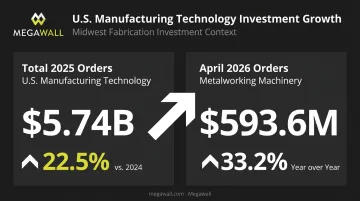
The capital investment data backs the adoption trend. AMT reported 2025 U.S. manufacturing technology orders of $5.74 billion, up 22.5% over 2024, with April 2026 metalworking machinery orders hitting $593.6 million — up 33.2% year over year.
For Midwest shops like Megawall in Comstock Park, Michigan, this plays out practically. Their 45,000 sq ft facility runs an HK PS3015 3000W fiber laser alongside press brakes, roll formers, and MIG/TIG/spot welding — an equipment stack that allows complete fabrication from prototype to production without outsourcing. That integration directly shortens the coordination delays that multi-vendor fabrication chains create.
Trend 2: Reshoring and the Midwest's Regional Fabrication Advantage
The U.S. reshoring wave hasn't crested. The Reshoring Initiative tracked 244,940 job announcements in 2024, following 287,299 in 2023 and 364,904 in 2022. The sectors driving these announcements — transportation equipment, electrical equipment, and electronics — all require fabricated metal inputs: enclosures, frames, brackets, skids, and process piping.
For Midwest fabricators, the geographic argument is straightforward:
- Michigan's auto sector generated $37.5 billion in manufacturing output in 2021 — 37% of the state's total manufacturing output (NAM)
- Indiana alone accounts for an estimated 25% of U.S. raw steel production (USGS, 2024), keeping material supply chains short
- The five-state Midwest fabrication workforce exceeds 380,000 people, a skilled labor base that supports rapid scaling for regional OEM buyers
When OEM buyers and industrial contractors evaluate domestic versus overseas sourcing, the case for regional fabricators rests on faster lead times, easier quality audits, lower freight costs, and the ability to make mid-run design changes without a 14-day ocean freight penalty. These advantages are structural, not temporary.
Trend 3: Sustainable Fabrication and Green Material Standards
Sustainability has moved from a marketing attribute to a procurement requirement. Buyers submitting projects for LEED certification need documentation from their fabrication partners — not just assurances.
The scale of LEED demand gives context: USGBC reports over 29 billion square feet of LEED-certified space globally, with LEED-certified buildings typically consuming 25% less energy and reducing carbon emissions by 34%. That footprint creates steady downstream demand for certified materials throughout the supply chain.
On the materials side, American structural steel already carries strong recycled credentials:
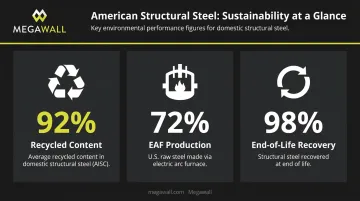
- AISC reports domestic structural steel contains 92% recycled content on average
- Electric arc furnaces account for 72% of U.S. raw steel production, inherently leveraging scrap inputs
- 98% of structural steel is recovered at end of life, supporting circular procurement arguments
Fabricators with documented sustainability credentials are winning contracts that less-credentialed competitors cannot access. Megawall's LEED-certified aluminum slatwall — manufactured from over 50% recycled content and verified as formaldehyde-free — illustrates how sustainability credentials can be embedded directly into manufactured metal end products. For retail clients building new locations or retrofitting existing spaces with LEED targets, that certification documentation simplifies their own compliance reporting.
On the operational side, shops investing in fiber laser systems, closed-loop scrap recycling, and low-waste nesting software are reducing both their environmental footprint and their raw material costs simultaneously.
Trend 4: Custom, Low-Volume, and Agile Production Runs
The shift away from high-volume commodity fabrication toward short-run, application-specific production reflects a broader change in how industries buy. Retail fixture manufacturers, food processing equipment suppliers, agricultural machinery builders, and medical equipment fabricators increasingly need parts configured to project specifications — not standard catalog sizes.
IBISWorld values the U.S. Fabricated Structural Metal Manufacturing market at $65.5 billion in 2026. The growth within that market is weighted toward variable, quote-intensive work rather than commodity runs.
Agile fabrication capabilities that are becoming competitive differentiators:
- Flexible tooling and quick-change press setups that reduce changeover time between short runs
- Rapid quoting systems that can price custom configurations without multi-day engineering reviews
- Prototype-to-production pipelines that let customers test a single component before committing to a full run
The FMA data reinforces this: 46% of fabricators are investing in quoting and estimating software, and 34% are prioritizing scheduling tools — both investments that pay off primarily in high-mix, variable-volume environments. Megawall's explicit capability to handle "single part prototyping to large scale production" reflects exactly this model — the ability to serve a customer testing a concept and then scale alongside them.
Trend 5: Piping Fabrication Modernization — Prefab, BIM, and Advanced Joining
Industrial and commercial piping fabrication is moving off-site. Prefabricated pipe spool assemblies built in a controlled shop environment reduce on-site labor hours, improve dimensional consistency, and allow quality inspection before installation begins.
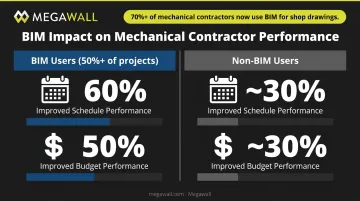
Dodge research found that over 70% of mechanical contractors use BIM for shop drawings and spatial coordination on at least half of their projects, with 61% using it for constructability evaluation. Contractors using BIM on at least 50% of projects reported improved schedule performance 60% of the time and improved budget performance 50% of the time — compared to roughly 30% for non-BIM users.
What BIM integration delivers for piping fabrication:
- Accurate spool drawings generated from coordinated 3D models
- Clash detection before fabrication begins, not during installation
- Precise material takeoffs that reduce overordering and waste
- Tighter connection between design intent and shop output
On the joining side, orbital GTAW (gas tungsten arc welding) is gaining use in high-specification piping applications — biopharmaceutical, semiconductor, and food-grade systems where leak integrity is non-negotiable. Modern orbital systems automate travel speed, arc gap, and gas flow, removing operator variability from the most critical weld parameters.
What's Driving These Fabrication Trends in the Midwest
Several forces are converging at once — and reinforcing each other.
Technology accessibility: Fiber laser systems, cobots, and cloud-connected ERP platforms have dropped in integration complexity to the point where mid-sized Midwest shops — not just national players — can justify the capital and operational investment.
Customer expectations: OEM buyers and construction contractors are placing tighter demands on fabricators: faster quoting, tighter tolerances, full material traceability, and documented on-time delivery. Shops that can't meet those requirements are losing contracts to those that can.
Cost pressures: BLS data shows import prices for primary metal manufacturing have moved 5.4% higher from December 2021 to December 2024, with significant volatility in between. Industrial electricity rates averaged 8.58 cents/kWh in early 2025, up 3.9% year over year (EIA). Those pressures push shops toward nesting optimization, scrap reduction, and automated secondary operations to protect margins.
Regulatory and compliance requirements: Building codes, OSHA piping system requirements, environmental reporting mandates, and sustainability certifications are influencing material specifications and process documentation across fabrication projects — particularly for shops serving construction and industrial clients.
How These Trends Are Impacting the Midwest Fabrication Industry
Operational Impact
Automation and digital tools are compressing lead times and improving first-pass quality rates across fabrication operations. Deloitte's 2025 Smart Manufacturing survey found average benefits of 10%–20% production output gains and 7%–20% employee productivity gains among manufacturers implementing smart manufacturing practices — giving smaller shops a meaningful competitive lever when they invest.
Shops with integrated fiber laser, press brake, and welding capabilities under one roof can eliminate handoff delays and quality gaps that multi-vendor chains introduce. Buyers awarding contracts based on turnaround speed are increasingly filtering for this kind of single-source capability.
Business Impact
Reshoring demand and the custom-production trend are opening contracts that were previously going to overseas suppliers or distant national shops. Vertically integrated fabricators — those with in-house design, engineering, fabrication, and finishing — hold a clear advantage: they can move from customer spec to shipped product without external dependencies.
For Midwest-based fabricators with this capability, the reshoring window represents a durable opportunity. Companies that reshored during 2020–2022 are now formalizing domestic-first procurement policies — and they need regional partners who can scale with them.
Workforce Impact
The skilled labor constraint isn't easing. Key projections illustrate the scale of the gap:
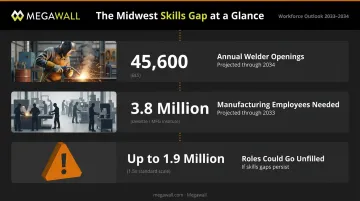
- BLS projects 45,600 average annual welder openings through 2034, alongside 34,200 annual machinist and tool-and-die maker openings
- Deloitte and The Manufacturing Institute project a net need for 3.8 million manufacturing employees through 2033
- Up to 1.9 million of those roles could go unfilled if skills gaps persist
Shops responding effectively are investing in cross-training, simulation-based welding and CNC training, and apprenticeship pipelines that develop internal talent rather than competing for a shrinking external pool.
Future Signals for Midwest Sheet Metal & Piping Fabrication
Three technology shifts and three market forces are converging over the next one to three years — and Midwest fabricators are already reacting.
Technologies to watch:
- AI-assisted quoting and DFM review: Xometry launched instant tube fabrication quoting in late 2024. Expect this capability to spread across more fabrication types and platforms throughout 2025–2026.
- Hybrid additive-subtractive manufacturing now enables complex sheet metal geometries that conventional cutting and forming can't produce economically — opening design possibilities previously ruled out on cost grounds.
- Advanced orbital welding automation is moving beyond pharmaceutical and semiconductor piping into industrial and data center applications, driven by tighter consistency requirements.
Near-term scenarios:
- Mid-sized Midwest fabricator consolidation will accelerate: KPMG's 2026 report confirms a surge in metal fabrication M&A driven by strategic buyers and growing investor interest.
- Carbon footprint documentation will increasingly accompany fabrication orders, not just building material procurement
- Prefabricated piping for data center construction will grow sharply. Data centers accounted for more than 70% of the increase in private nonresidential construction spending between March 2024 and March 2025, according to Construction Dive.
The common thread: fabricators who invest in automation and documentation capabilities now will be first-mover suppliers when these signals become procurement requirements. Start identifying which of your fabrication partners are already moving in these directions.
Conclusion
The fabrication trends reshaping the Midwest — automation investment, sustainability requirements, reshoring-driven demand, and the shift toward custom production — are compressing the window for adaptation. For retailers sourcing metal display fixtures and shelving systems, these shifts have a direct impact on what's available, at what quality level, and from whom.
Regional sourcing now carries real operational advantages. Midwest fabricators with in-house laser cutting, forming, welding, and finishing capabilities can compress lead times and reduce the documentation risk that comes with extended overseas supply chains. For retail buyers specifying heavy-duty steel or LEED-certified aluminum systems, proximity to manufacturing isn't just convenient — it supports faster adjustments, tighter quality control, and more responsive custom production.
Michigan's manufacturing base sits at the center of this transition. Fabricators with the workforce tenure, equipment investment, and vertical integration to meet modern retail specifications are positioned to serve buyers who can't afford delays or quality inconsistencies on the floor.
The shops and buyers that build those partnerships now will be the ones dictating terms as demand continues to tighten.
Frequently Asked Questions
What are the future trends and industry outlook for custom sheet metal and piping fabrication in the Midwest?
Automation adoption, reshoring-driven demand, and prefabricated piping growth are the primary near-term drivers. AI-assisted quoting tools and BIM-integrated pipe spool fabrication are moving from early adoption to standard practice, creating measurable advantages for shops that invest now.
Are custom sheet metal and piping fabricators in demand in the Midwest?
Demand is strong and growing. The region's industrial base, reshoring momentum, and concentration of automotive, construction, and agricultural industries create consistent need for localized fabricators with faster lead times and hands-on quality oversight.
What industries drive the most demand for sheet metal fabrication in the Midwest?
Automotive, agriculture, construction, food processing, industrial equipment, and retail fixtures are the dominant sectors. Michigan's auto corridor and Indiana's steel infrastructure anchor much of this demand, with construction and retail fixture sectors contributing meaningfully to overall output.
How is automation changing the sheet metal fabrication workforce?
Automation is shifting demand toward higher-skilled roles: CNC programming, robotic cell operation, and quality inspection. Manual repetitive tasks are declining, and fabricators are responding by investing in cross-training and simulation-based programs to build these skills internally.
What makes Midwest-based fabricators a competitive choice over overseas alternatives?
Faster lead times, direct quality oversight, lower freight costs, and the ability to handle custom or short-run orders without minimum quantity constraints give Midwest fabricators a clear edge over overseas alternatives. Communication and design flexibility also improve significantly when fabricator and buyer are in the same time zone.
How does sustainability factor into modern sheet metal and piping fabrication?
Buyers increasingly require recycled-content materials, LEED-compliant components, and documented waste reduction practices as part of standard procurement. Fabricators with certified sustainable processes and verified recycled-content materials (such as aluminum products with 50%+ recycled content) are winning more competitive bids as these requirements become standard.