Introduction
The wrong fabrication partner doesn't just slow you down — it shows up in your store. Warped displays, late shipments, and fixtures that fail under load all trace back to a vendor selection decision made months earlier. For retailers managing multi-location rollouts or seasonal resets, those failures compound fast.
The challenge is real: the U.S. structural metal product manufacturing market is valued at $84.6 billion in 2026, with thousands of fabricators competing for your business. Most can cut and weld metal. Far fewer understand what a retail environment actually demands: load-bearing fixtures that survive daily customer contact, finishes that hold up through seasonal resets, and compliance specs your store operations team won't need to fight over.
This guide gives you four practical tips to separate capable fabrication partners from shops that treat retail as an afterthought, plus a pre-qualification checklist to use before you commit.
Key Takeaways
- Industry-specific experience reduces costly design revisions and prevents spec errors before production starts
- In-house end-to-end capabilities eliminate vendor handoffs that introduce delays and quality gaps
- Certifications like LEED and fire code compliance protect you from liability and support ESG commitments
- Pre-contract communication quality predicts how a partner will behave when problems arise mid-project
- Long-tenured teams carry institutional knowledge that pays off on complex or repeat retail orders
What Is a Metal Fabrication Partnership?
In the retail context, metal fabrication means cutting, forming, welding, and finishing metals (primarily steel and aluminum) to produce custom display fixtures, slatwall systems, and structural components that meet your specific display and structural requirements.
What separates a fabrication partner from a transactional vendor comes down to accountability. A vendor delivers your order and moves on. A true partner collaborates on design from the start, flags production risks before they become delays, and stays invested in the success of your ongoing display program. The difference shows up in how they handle your project day-to-day:
- Flags potential issues early rather than surfacing problems at delivery
- Manages timelines proactively and communicates changes before they cascade
- Collaborates on design and specification refinements
- Treats your program as a long-term relationship, not a one-time transaction
That distinction matters most when production hits a snag. At scale, it's not a question of if — it's a question of how fast your partner responds.
4 Essential Tips for Choosing Your Metal Fabrication Partner
Selecting the right fabrication partner depends on the scale of your retail operation, the complexity of your fixture requirements, and the support you'll need over time. These four tips give you a structured way to evaluate any fabricator before you commit.
Tip 1: Look for Proven Experience in Retail or Commercial Display Applications
General-purpose fabricators know metal. Retail-experienced fabricators know what happens to metal in a store : daily handling, seasonal resets, and the load requirements that vary across product categories. The difference shows up in whether your fixtures perform or fail.
Key experience signals to evaluate:
- Years in business and whether their track record includes major national retailers
- Types of retail clients served — a fabricator serving big-box chains operates at a different standard than one serving single-location shops
- Patented or proprietary solutions, which indicate genuine innovation rather than commodity production
Megawall, for example, introduced the first wall display system patented with a concealed fastener in the late 1980s — a solution to the very real problem of visible hardware degrading retail aesthetics. Innovation like that requires deep familiarity with what retailers actually need, not just the ability to bend metal.
An experienced partner also compresses your timeline. When a fabricator already understands slatwall load requirements, fire code constraints, and retail finish standards, the back-and-forth that burns weeks in the design phase shrinks considerably.
Tip 2: Evaluate Whether They Offer Complete, End-to-End Capabilities
Every handoff between vendors is a potential failure point. Miscommunications about tolerances, finish inconsistencies, and packaging errors can each derail a rollout. The most reliable fabrication partnerships happen when design, engineering, fabrication, finishing, and shipping all stay under one roof.
Capabilities to verify before signing:
- In-house design and engineering (not just a reference to "CAD support")
- Laser cutting, forming, welding, and machining performed on-site
- Finishing options including powder coating
- Custom packaging for retail display components
- Logistics and LTL freight handling
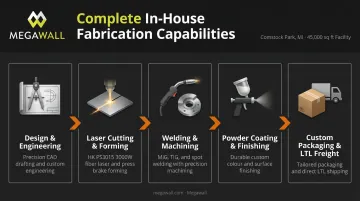
Megawall operates a 45,000 sq. ft. facility in Comstock Park, Michigan, with all of these capabilities in-house — including an HK PS3015 3000W fiber laser, press brakes, roll forming, MIG/TIG/spot welding, and full shipping infrastructure. Nothing gets handed off to a subcontractor.
This matters for more than speed. When a production issue surfaces — say, a finish that isn't matching your brand color — an in-house team can respond the same day. A fabricator who outsources finishing or packaging can't make that promise.
Business outcome: A single-source fabricator simplifies quoting, consolidates vendor accountability, and gives you one contact point when something needs to change.
Tip 3: Verify Quality Standards, Certifications, and Compliance
Certifications are process controls, not just credentials. ISO 9001:2015 specifies quality management system requirements for consistently delivering products that meet customer and regulatory standards — it tells you a fabricator has documented, repeatable processes, not just good intentions.
Certifications and standards relevant to retail fabrication:
- ISO 9001 — Quality management system; confirms documented processes and accountability for non-conforming parts
- LEED certification — Applies when metal fixtures count as permanently installed building products; USGBC calculates recycled content as postconsumer plus one-half preconsumer content
- Fire code compliance — The 2024 International Fire Code Chapter 8 covers interior finish, furnishings, and decorative materials with Class A/B/C flame-spread thresholds; verify that coatings and structural components meet applicable requirements
Megawall's aluminum slatwall is manufactured from over 50% recycled content and carries LEED certification — a concrete advantage for retailers with environmental compliance goals. Steel slatwall meets fire codes for commercial interiors, which matters for any display deployed as interior finish or partition in a retail space.
Working with a certified fabricator reduces rework costs, liability exposure, and compliance surprises — especially on large-scale rollouts across multiple locations where a single non-conforming product runs across every store.
Tip 4: Test Communication Quality and Long-Term Partnership Mindset
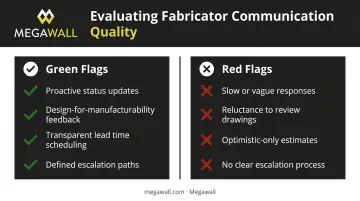
How a fabricator communicates during the quoting phase is a reliable preview of how they'll behave when a production issue surfaces at week six of a twelve-week rollout. Slow responses, vague answers, and reluctance to review drawings are warning signs — not just inconveniences.
What strong communication looks like in practice:
- Proactive status updates without you having to chase them
- Willingness to review drawings and suggest design-for-manufacturability improvements
- Clear lead times with transparent scheduling, not optimistic estimates
- Defined escalation paths when something goes wrong
Beyond responsiveness, look at team stability. The U.S. median worker tenure is 3.9 years as of January 2024. A fabrication shop where employees stay significantly longer than that benchmark has accumulated institutional knowledge that benefits you directly: they've seen your type of project before, they know what causes problems, and they don't need to relearn processes from scratch on your order.
Megawall's 25+ employees average 12.5 years of tenure. Client feedback reflects it: "We have projects with very tight deadlines and MegaWall helps us meet the challenges and still maintain excellent quality."
Long-term partnerships also grow with your business. A team that knows your display program, your brand standards, and your seasonal cadence executes repeat orders faster and with fewer errors than a team starting from scratch each time.
Questions to Ask Before You Commit
Use this checklist when reaching out to prospective fabrication partners. The answers will tell you quickly whether you're dealing with a transactional vendor or someone invested in your success.
What retail or commercial clients have you worked with? Ask for references from retailers at a comparable scale to your operation.
Do you handle all fabrication stages in-house, or do you subcontract any steps? Get specific — forming, finishing, packaging, and freight are common outsourcing points.
What certifications do you hold, and how do they apply to my requirements? Ask about ISO 9001, LEED documentation, and fire code compliance for your specific product.
What is your typical lead time for an order at my volume, and how do you handle rush requests? The metal fabrication industry average on-time delivery rate is 84% — ask for their specific history.
Can you show me your facility, either in person or via virtual tour? Seeing the operation firsthand validates claims about capacity, equipment, and culture that written materials alone can't confirm.
Why Megawall Is the Right Metal Fabrication Partner for Retailers
Megawall is a family-owned manufacturer with more than 35 years focused exclusively on metal retail display systems. Today, its products are found in most major retailers across North America.
What that looks like in practice:
- 45,000 sq. ft. facility with complete in-house fabrication — laser cutting, forming, welding, machining, assembly, and shipping — no subcontractors, no handoffs
- LEED-certified aluminum slatwall made from 50%+ recycled content, supporting retailers with environmental and ESG compliance requirements
- Steel slatwall engineered to meet fire codes for commercial interiors, holding over 50 lbs per linear foot
- 25+ employees with an average tenure of 12.5 years, bringing deep institutional knowledge to complex rollouts and repeat seasonal programs
- Patented concealed fastener system — the original design, still refined and in use today, built to solve real merchandising problems at scale
Megawall's philosophy is direct: "We partner with you during every stage of the process; problem solving to ensure your products are displayed in the finest way possible." For retailers managing display programs at scale, that means one team, one point of contact, and accountability from concept through delivery.
Conclusion
Choosing a metal fabrication partner is a strategic decision. The right partner helps you cut long-term fixture costs, keep display programs on schedule, and avoid the compliance surprises and rework that come from misaligned vendors.
As retail environments shift and product lines evolve, the best fabrication partnerships grow with the business. Evaluating a partner on experience, in-house capabilities, certifications, and communication will consistently deliver better outcomes than choosing on price alone. Megawall has built its business on exactly that model — 21+ years of serving major North American retailers from a single, fully equipped fabrication facility in Comstock Park, MI.
Frequently Asked Questions
What is the 4T rule in sheet metal fabrication?
The 4T rule is a design-for-manufacturability guideline for keeping features away from bend zones. It typically means slots should be placed at least four times the material thickness from a bend line to prevent deformation or tearing during forming. Some guidance applies a lower multiplier (2.5T) to holes specifically — so always validate feature placement with your fabricator's tooling requirements.
How much does metal fabrication cost per hour?
Shop rates vary widely by process, equipment, and region. Industry figures often cite welding near $70/hr and laser cutting near $150/hr, but hourly rate alone is a poor benchmark. Evaluate total value — quality consistency, lead time, and responsiveness — to get a true picture of cost.
What certifications should a metal fabrication company have?
For retail applications, ISO 9001 confirms a documented quality system, LEED certification supports sustainability credentials, and fire code compliance is required for commercial interior fixtures. Certifications that matter depend on your application, so ask your fabricator which apply to your specific product.
What is the difference between steel and aluminum slatwall displays?
Steel slatwall offers high load capacity and durability, making it suited for heavy merchandise and high-traffic environments. Aluminum slatwall is lighter, corrosion-resistant, and available in LEED-certified options with 50%+ recycled content. Both can hold over 50 lbs per linear foot — the best choice depends on product weight, aesthetic goals, and sustainability requirements.
How do I evaluate a metal fabricator's quality control process?
Ask about documented inspection procedures, ISO 9001 certification scope, and how the fabricator handles non-conforming parts before delivery. Request specifics on measurement tools and verification steps used during production. A fabricator who answers these questions with specifics and offers documentation is demonstrating quality control in action — not just describing it.