The North America contract fabrication services market reflects this demand directly: valued at $65.95 billion in 2025 and projected to reach $103.68 billion by 2033, according to Grand View Research.
This article covers the fabrication process from concept to finished product, the core benefits, real-world applications across industries, best practices for project success, and what to look for in a fabrication partner.
Key Takeaways
- Custom fabrication engineers components to exact specifications, not adapted from standard stock
- The process spans design, cutting, forming, welding, and finishing, with each stage affecting final quality
- Precision-cut parts reduce installation rework and system integration failures
- Material selection and finish choices directly affect longevity, compliance, and sustainability credentials
- End-to-end in-house fabrication capabilities reduce lead times and consolidate accountability
What Is Custom Metal Fabrication?
Custom metal fabrication is the process of designing, cutting, shaping, welding, and finishing raw metal into products built to a client's exact specifications. The distinction from mass production matters: standard manufactured components are made at high volume for general use, then adapted by the buyer if needed. Custom fabrication starts with the end-use requirement and engineers backward from there.
That engineering process begins with a material decision. Different metals perform differently under load, in corrosive environments, or against specific aesthetic requirements — so the choice of material is inseparable from the design itself:
- Steel — high strength, cost-effective for structural applications
- Aluminum — lightweight, corrosion-resistant, highly recyclable
- Stainless steel — hygienic, durable, suited to food and medical environments
- Copper and brass — conductivity and aesthetic applications
- Specialty alloys — extreme temperature or pressure environments
Scale ranges from single-part prototypes to large production runs. That range makes custom fabrication practical for retail display systems, aerospace components, water treatment equipment, and commercial construction — any application where off-the-shelf parts won't meet the actual requirement.
The Custom Metal Fabrication Process: From Concept to Finished Product
Designing and Engineering
Every project starts with translation — converting a client's concept into a manufacturable plan. Fabricators use CAD (computer-aided design) and CAM (computer-aided manufacturing) software to build detailed 3D models, validate geometry, and identify structural or tolerance issues before any metal is cut.
Material selection happens at this stage. The choice between steel and aluminum, for example, isn't purely a cost decision: it depends on load requirements, operating environment, weight targets, finish expectations, and whether sustainability certifications such as LEED matter for the project.
Getting this right in the design phase prevents expensive changes later. According to PMI, rework can account for up to 50% of total project cost in some project environments, which makes front-loading the engineering work a sound investment.
Cutting and Shaping
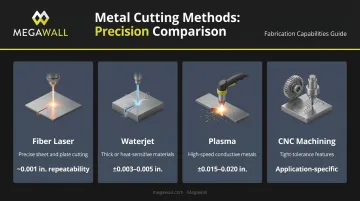
Modern fabrication shops use several cutting methods, each suited to different materials and complexity levels:
| Method | Best For | Typical Tolerance |
|---|---|---|
| Fiber laser | Precise sheet/plate cutting, intricate patterns | ~0.001 in. repeatability |
| Waterjet | Thick or heat-sensitive materials | ±0.003–0.005 in. |
| Plasma | High-speed cutting of conductive metals | ±0.015–0.020 in. |
| CNC machining | Tight-tolerance secondary features | Application-specific |
After cutting, forming equipment shapes the metal: press brakes for bending, roll formers for curved profiles, and stamping or punching for repeating patterns. CNC-controlled forming ensures consistency across production runs, which matters most when producing panels or components that must interlock or align precisely at installation.
Welding, Assembly, and Finishing
Welding joins cut and formed components. MIG welding suits high-production work on steel; TIG welding delivers cleaner, more precise joints on aluminum and thinner materials; arc welding handles heavier structural work. The AWS D1.1/D1.1M:2025 Structural Welding Code governs requirements for steel welded structures — skilled welders remain essential even when automated equipment handles part of the process.
Finishing is the final production stage, and each method serves a functional purpose beyond appearance:
- Deburring and grinding — remove sharp edges and surface irregularities
- Powder coating — durable protective layer; architectural grades like AAMA 2604 and 2605 are rated for 5–10 years of performance
- Anodizing — electrolytic process that hardens aluminum surfaces and resists corrosion (governed by ASTM B580)
- Galvanizing and zinc plating — corrosion protection for steel in challenging environments (ASTM B633)
Finish selection directly affects corrosion resistance, compliance with environmental or fire safety requirements, and product service life.
Key Benefits of Custom Metal Fabrication
Precision That Reduces Installation Rework
Custom-fabricated parts are engineered to exact dimensional tolerances. They integrate into existing systems without modification, which reduces installation time and eliminates the hidden costs of adapting components that don't quite fit. For complex assemblies like conveyor systems, structural supports, and multi-panel display walls, that precision compounds across every connection point — meaning fewer surprises during installation.
Design Flexibility Beyond Catalog Limits
Custom fabrication accommodates geometry, material combinations, and finish requirements that catalog products can't replicate. That's how innovations like concealed fastener systems become possible.
Megawall introduced the first wall display system patented with a concealed fastener in the late 1980s. The system creates seamless wall display sections up to 8 feet long with no visible hardware — a result that no standard slatwall product could achieve. Since then, Megawall has expanded the patented concealed fastener technology across multiple aluminum spacing configurations — 1" on center, 1½" on center, and 3" on center — each developed through precision metal fabrication.
Long-Term Cost Effectiveness
Upfront costs for custom fabrication run higher than buying standard components. That said, the long-term economics frequently favor custom work, for several reasons:
- Metal is cut to spec, minimizing material waste (versus trimming oversized stock)
- Properly engineered components require less maintenance and last longer
- Avoiding retrofit modifications reduces total installation cost
- Recycled-content materials like aluminum (50%+ recycled content) can contribute to LEED certification, adding project value for sustainability-driven clients
Common Applications of Custom Metal Fabrication
Industrial and Structural Applications
Manufacturing, energy, water treatment, and food processing facilities rely on custom-fabricated tanks, pressure vessels, platforms, conveyors, and structural supports. These applications have no viable off-the-shelf alternative — they must meet simultaneous dimensional requirements and regulatory compliance.
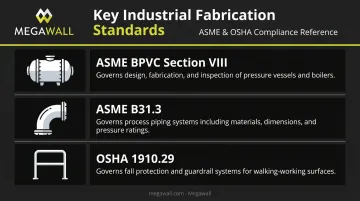
Key standards governing industrial fabrication include:
- ASME BPVC Section VIII — design and fabrication requirements for pressure vessels
- ASME B31.3 — process piping materials, fabrication, and testing
- OSHA 1910.29 — handrails and guardrail systems must withstand at least 200 lbs without failure
Custom fabrication is the only practical route to meeting both the dimensional specifics of a facility and these compliance requirements in a single component.
Architectural, Commercial, and Retail Display Applications
Architects and commercial designers specify custom fabrication for facades, staircases, railings, and structural steel elements where standardized products can't achieve the intended aesthetic or structural outcome. Ornamental and architectural metalwork — fences, handrails, balcony rails — accounts for a major share of custom fabrication work.
Retail display is a natural extension of that same discipline. Custom metal fabrication enables display systems built to specific load, dimensional, and aesthetic requirements that MDF alternatives can't match.
Megawall's steel and aluminum slatwall systems hold over 50 lbs per linear foot, meet fire codes, and are easy to clean — practical advantages for high-traffic retail environments. The aluminum line is manufactured from over 50% recycled content and carries LEED certification, qualifying for LEED v4.1 Material and Resources credits for recycled content in commercial projects. These specifications came from over two decades of precision fabrication development — not off a catalog shelf.
Automotive, Aerospace, and Consumer Goods
These sectors demand tolerances and material performance that mass production cannot reliably deliver at the required precision:
- Automotive — chassis components, engine brackets, custom structural parts
- Aerospace — components requiring extreme temperature and pressure tolerances
- Consumer goods — appliance housings, electronics enclosures, hardware components
Each application has different tolerance requirements and finishing standards, but the common thread is that the component must perform to a defined specification, not to whatever a standard part happens to deliver.
Best Practices for a Successful Custom Metal Fabrication Project
Front-Load the Design Phase
The most common source of cost overruns is design changes made after fabrication begins. Best practice:
- Finalize material selection before production starts — not during it
- Define tolerances and finish requirements in complete drawings, including surface finish grades, weld quality standards, and any testing requirements
- Use 3D prototypes or sample parts to validate the design at scale before committing to a full production run
The more completely a drawing defines dimensional tolerances and finish requirements (referenced to ASME B46.1), the less room there is for interpretation errors downstream.
Treat Material Selection as a Strategic Decision
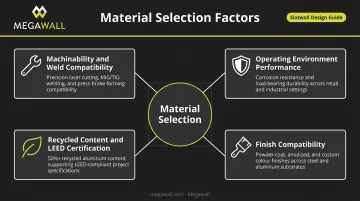
Raw material cost is one factor. The full decision should also weigh:
- Whether the material machines and welds cleanly with your intended processes
- How the metal performs in the product's actual operating environment — moisture, chemicals, UV exposure
- Recycled content and sustainability certifications — LEED-qualifying aluminum (50%+ recycled content) carries real weight for retailers building to green standards
- Finish compatibility — not every metal anodizes or powder-coats the same way, and finish options affect both appearance and long-term protection
Build Quality Checkpoints Into the Production Schedule
Final inspection alone catches defects too late. Specify in-process inspection milestones:
- Post-cutting — verify dimensional accuracy before forming
- Post-welding — inspect joint quality and structural integrity
- Pre-finish — catch surface defects before coating locks them in
Early detection reduces scrap, stops one defect from triggering the next, and ensures the finished product meets both functional and aesthetic requirements without production delays.
What to Look for in a Custom Metal Fabrication Partner
End-to-End In-House Capabilities
A fabricator that handles design engineering, fabrication, finishing, packaging, and shipping under one roof eliminates handoff errors between vendors. Multi-vendor arrangements fragment quality accountability and extend lead times.
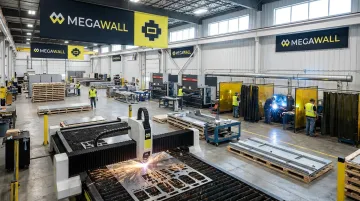
Megawall operates a 45,000 sq ft facility in Comstock Park, MI, with in-house design engineering, fiber laser cutting, metal forming, MIG/TIG/spot welding, machining, assembly, and full shipping and packaging. That single-facility setup means one point of accountability from concept to delivery.
Technical Depth and Workforce Tenure
Look for fabricators with demonstrated experience in your specific application, not just general metalwork. In-house engineering resources capable of reviewing and improving designs are especially useful during the design validation phase.
Workforce tenure signals process consistency. Megawall's team of 25+ employees averages 12.5 years of tenure — technicians who have built the same systems hundreds of times carry institutional knowledge that new hires take years to develop. According to NIST MEP, workforce retention is among the top two business challenges cited by manufacturers, making long-tenured teams a measurable advantage in consistent quality and process reliability.
Certifications and Compliance Credentials
Depending on your application, verify:
| Certification | What It Confirms |
|---|---|
| AWS D1.1 / CWI Endorsement | Structural steel welding quality |
| ASME BPVC Section VIII | Pressure vessel design and fabrication |
| ISO 9001:2015 | Quality management system requirements |
| LEED (recycled content) | Sustainable material sourcing for green building projects |
Ask for documentation — self-reported compliance and independently verified certification are not the same thing.
Frequently Asked Questions
What is the difference between custom metal fabrication and standard metal manufacturing?
Standard manufacturing produces identical parts at high volume for general use. Custom fabrication engineers components to a client's specific dimensions, material requirements, and functional needs, making it the right choice when off-the-shelf parts simply won't meet the performance or dimensional requirements of the project.
What metals are most commonly used in custom metal fabrication?
Steel (strength, cost-effectiveness), aluminum (lightweight, corrosion-resistant, recyclable), stainless steel (hygiene and durability), and copper (conductivity) are the most common. The best choice depends on the application's load requirements, operating environment, and finish specifications.
How long does the custom metal fabrication process typically take?
Timelines vary based on complexity, quantity, material lead times, and finishing requirements. Working with a fabricator that has all capabilities in-house generally reduces lead times compared to multi-vendor arrangements where each handoff adds scheduling risk.
What industries benefit most from custom metal fabrication?
Manufacturing, construction, aerospace, automotive, medical, and retail display rely on custom fabrication most heavily. Retail applications in particular — from display fixtures to structural shelving — often demand precise load ratings, custom dimensions, and finishes that standard catalog parts can't deliver.
What should I look for when choosing a custom metal fabrication partner?
Prioritize in-house end-to-end capabilities, relevant industry experience, a tenured technical team, and relevant certifications. Strong communication and willingness to collaborate on design refinement before production starts are equally important.
How does custom metal fabrication support sustainable design goals?
Precision cutting minimizes material waste, and material choices like aluminum with high recycled content can earn LEED certification credits under the Materials and Resources category. That makes custom fabrication a practical fit for sustainability-driven projects, not just a performance choice.