Despite how ubiquitous they are, many store owners and merchandisers don't fully understand what gondola displays are, how they're built, or how to get the most out of them. Whether you're setting up a new store, planning a remodel, or optimizing an existing layout, understanding gondola displays from the ground up will help you make smarter decisions about your merchandising strategy.
This guide covers everything: the definition and anatomy of a gondola, the main types, where and how they're used, key merchandising best practices, and when wall display systems can complement or replace them.
Key Takeaways
- A gondola display is a freestanding, double-sided shelving unit that forms the product aisles in most mid-to-large retail stores
- Back panel type (flat, pegboard, or slatwall) determines which accessories and products a gondola can hold
- Endcap positions deliver ~93% more product exposure than standard mid-aisle shelf positions
- Eye-level placement (roughly 36–60 inches from the floor) generates the highest shopper attention and purchase rates
- Aluminum slatwall back panels outperform MDF on durability, load capacity, and overall return on investment
What Is a Gondola Display in Retail?
A gondola display is a freestanding, double-sided shelving unit designed to display merchandise on a retail sales floor. Unlike wall shelving fixed to the store perimeter, gondolas stand independently in the middle of the floor — shoppers can access products from both sides, and multiple units lined end-to-end create the product aisles most shoppers navigate every day.
Why Are They Called Gondolas?
The name comes from the long, narrow Venetian gondola boat. When gondola shelving units are lined up in rows and viewed from above, the shape and layout closely resembles the narrow, elongated hull of a gondola. Today, "gondola" is the standard trade term used by retailers, fixture suppliers, and store planners across North America.
Physical Structure and Dimensions
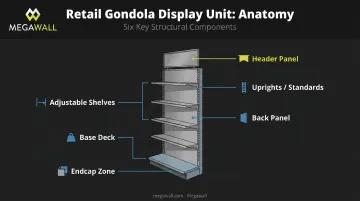
A standard gondola unit includes several core components that work together:
- Base deck — a weighted, low-profile platform that anchors the unit and provides stability
- Uprights/standards — vertical metal frames on each side, slotted to accept shelves and accessories at multiple heights
- Back panel — the vertical surface between the uprights (flat, pegboard, or slatwall)
- Adjustable shelves — horizontal shelves that slot into the uprights at customizable heights
- Endcap zone — the short end of a gondola row, typically reserved for promotional or high-visibility displays
- Header panel — optional signage area mounted at the top of the unit
Standard gondola heights range from 48 to 96 inches — 54 inches is common in convenience stores, while 72 inches is typical in supermarkets. Shelf widths are most commonly 36 or 48 inches, according to Rack Leaders' gondola shelving dimensions guide.
Base shelf depths generally run 16 to 24 inches; upper shelves are shallower at 10 to 19 inches, keeping products visible and reachable at eye level.
The slotted uprights drive the system's flexibility — shelf height adjusts without tools, making gondolas far easier to reconfigure than fixed wall shelving.
Types of Gondola Display Systems
The back panel is what really differentiates one gondola type from another. The panel determines what accessories the unit can hold, how merchandise is hung or stacked, and how easily the display can be reconfigured.
Shelving Gondolas
The most common configuration. Shelving gondolas feature a flat or solid hardboard back panel with adjustable horizontal shelves, designed for packaged goods, canned products, folded apparel, and boxed merchandise — any product that sits on a flat surface.
Shelf height adjusts in one-inch increments on most systems, which makes shelving gondolas versatile across product categories. The flat back panel is also the simplest to clean and maintain.
Pegboard Gondolas
These replace the flat panel with a pegboard back — a sheet with evenly spaced holes (typically 9/32-inch holes spaced 1 inch apart on Lozier systems) that accept standard peg hooks and accessories.
Pegboard gondolas work best for small, individually packaged items: stationery, hardware fasteners, fishing tackle, party supplies, and similar categories with many SKUs and small package sizes. The hooks allow products to hang face-forward, maximizing visibility for items that are difficult to shelf-stack.
Slatwall Gondolas
Slatwall gondolas feature horizontal grooved panels — typically spaced 3 inches apart — as the back surface. These grooves accept a wide range of accessories (hooks, shelves, bins, brackets) without requiring tools, making reconfigurations fast.
Panel material is the critical variable. The three common options differ significantly in load capacity and durability:
| Panel Type | Load Capacity | Key Limitation |
|---|---|---|
| Unreinforced MDF | ~12 lbs per bracket | Moisture damage; groove breakout under load |
| Factory-reinforced MDF (aluminum inserts) | ~50 lbs per bracket | Higher cost than standard MDF; still susceptible to moisture over time |
| Aluminum slatwall | 50+ lbs per linear foot | Higher upfront cost |
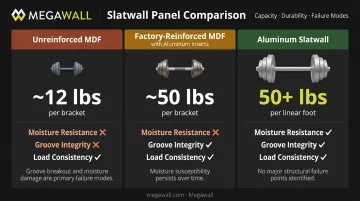
According to American Retail Supply's slatwall weight guidance, groove breakout — where the top of the groove cracks under load — is the primary failure mode for unreinforced MDF, often requiring full board replacement rather than spot repair.
Aluminum slatwall eliminates these failure points. Megawall's NuPanel Gondola Retrofit panels, for example, drop directly into standard 36-inch or 48-inch gondolas using existing slotted uprights. They hold over 50 lbs per linear foot, won't warp or delaminate, and are LEED-certified with 50%+ recycled aluminum content.
Where and How Gondola Displays Are Used in Retail
Big-Box and Grocery Environments
In large-format stores — Walmart, Kroger, Target — dozens or hundreds of gondola units are placed end-to-end to create category aisles. Each unit faces two shopping lanes simultaneously. The top shelf often serves as "top stock": overstock kept on the sales floor to reduce backroom clutter. Walmart's top stock program moved inventory from back rooms to gondola top shelves and produced a 75% reduction in back-room inventory during a pilot program, per Retail Dive.
Specialty and Small-Format Retailers
Boutiques, bath-and-body shops, and candle stores use individual gondola units differently — as freestanding island displays scattered through the store rather than long aisles. Each unit highlights a single product theme or category and acts as a self-contained display, encouraging shoppers to stop and browse.
Endcap Placement
Regardless of store format, one placement type consistently outperforms the rest: the endcap. The ends of gondola rows are the highest-traffic spots on the floor. Research from Oracle Retail and the University of South Carolina found that endcap placement gives a product approximately 93% more exposure than standard shelf positions. A 2022 Journal of Retailing study confirmed that front endcap displays have the largest effect on category purchase decisions. Optimized placement in these positions produces average revenue increases of around 11%.
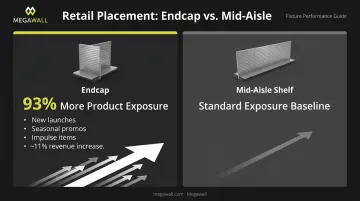
Endcaps are typically used for:
- New product launches
- Seasonal promotions
- Trade-promotion "feature and display" programs
- Impulse or high-margin items
Impulse and Point-of-Purchase Zones
Single gondola units placed near checkout lanes or high-traffic transitions are effective for impulse merchandising. InContext Solutions reports that 87% of U.S. shoppers have made an impulse purchase at checkout. Low-consideration products with a quick decision cycle — gum, batteries, travel-size toiletries, and similar grab-and-go items — perform especially well here.
Key Gondola Merchandising Best Practices
Eye-Level Placement
"Eye level is buy level" is one of the most consistent principles in retail merchandising. Research published in the Journal of Marketing found that top-shelf positions increased visual attention and choice by 20% compared to lower positions. Middle shelves improved attention but didn't consistently convert to purchases.
As a practical framework:
- 36–60 inches from the floor: Best-sellers, highest-margin SKUs, new launches
- Below 36 inches: Bulkier items, value packs, family sizes
- Top shelf: Safety stock, secondary SKUs, overstock
Vertical vs. Horizontal Blocking
These are two different approaches to arranging products on a gondola:
- Vertical blocking groups a single brand in a column from top shelf to bottom. As shoppers walk down the aisle, the brand is easy to spot as a visual unit. Best for brand-led merchandising strategies.
- Horizontal blocking groups products by type or variant across an entire shelf level. Shoppers see all variations of one product type at the same height. Best for category-led strategies where comparison matters.
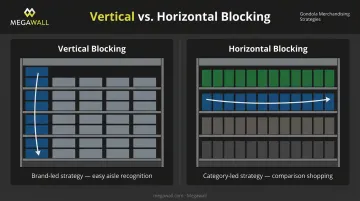
Choose vertical blocking when brand recognition drives purchase decisions. Choose horizontal blocking when shoppers are comparing variants — flavors, sizes, price tiers — and need to see options side by side.
Product Facing and Shelf Density
A "facing" is the number of units visible at the front of a shelf. The Journal of Marketing research found that doubling facings increased visual attention by 28% and purchase choice by 10%.
The goal is to keep shelves looking full and organized without overcrowding:
- Overcrowded shelves create confusion and slow shopping
- Under-filled shelves signal poor stock management
- Use shelf dividers or pusher systems to maintain facing consistency between restocks
Planogram Alignment
A planogram is a visual map that dictates exactly where each product belongs on a gondola — shelf position, facing count, and sequence. RELEX Solutions notes that store-specific planograms can increase sales by 1–3% and reduce waste by 5–10%.
For retailers selling through major chains, planogram compliance is required to:
- Qualify for promotional placement
- Meet category management standards
- Deliver a consistent shopper experience across locations
Signage and Header Use
A gondola's header panel and shelf-edge label strips reduce decision friction at the point of purchase. Clear category headers help shoppers navigate; price call-outs and promotional flags direct attention to featured items.
A 2021 survey cited by Marketing Dive found that 69% of shoppers recalled seeing in-store product advertising — and among those, 61% purchased the featured product. Shelf-edge and header signage are among the lowest-cost ways to influence the purchase decision.
Gondola Displays vs. Wall Display Systems
When Gondolas Are the Right Choice
Gondolas excel in:
- Large-format stores with broad product ranges and significant floor square footage
- Any environment where double-sided product access and flexible aisle configurations are needed
- High-SKU categories where maximizing shelf-linear-feet matters most
Limitations Worth Considering
Not all gondolas are created equal. Traditional units with MDF back panels or low-grade steel components have real drawbacks:
- MDF slatwall can warp, swell, and crack — especially in humid environments
- Low-grade steel uprights and shelves are prone to surface damage over time
- Poorly maintained gondolas detract from the shopping environment and undermine product perception
Before purchasing gondola components, evaluate material quality, back panel type, and long-term durability — not just upfront cost.
When Wall Systems Complement Gondolas
For perimeter walls and smaller store formats, wall-mounted slatwall systems are a space-efficient complement to mid-floor gondola fixtures. They maximize vertical wall space without consuming floor area.
Megawall's aluminum slatwall systems — with hidden fasteners and available in finishes like Clear Anodize, Black, White, and Raw Mill — pair directly with their NuPanel gondola retrofit panels. A retailer can use NuPanel to upgrade mid-floor gondola back panels and install matching aluminum slatwall along perimeter walls, keeping the same material and finish running from floor to ceiling throughout the store.
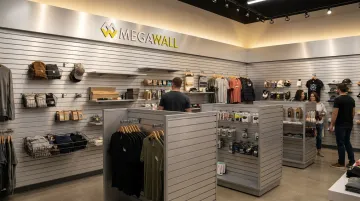
That continuity matters in high-traffic retail environments, where a fragmented mix of panel types and finishes can make an otherwise well-stocked store feel disorganized.
Frequently Asked Questions
What does gondola mean in retail?
In retail, a gondola refers to a freestanding, double-sided shelving unit used to display merchandise. Gondolas are placed on the sales floor either in long rows to form shopping aisles or individually as standalone island displays. They're one of the most widely used fixture types in retail environments worldwide.
Why are shelves called gondolas?
The name comes from the Venetian gondola boat. When gondola shelving units are lined up in long rows and viewed from above, the narrow, elongated layout resembles the hull of the boat. The term has been used in retail fixture terminology ever since.
What does gondola shelving look like?
Gondola shelving is a tall metal-framed unit with a flat weighted base, vertical slotted uprights, a back panel (flat, pegboard, or slatwall), and adjustable shelves accessible from both sides. In practice, it's the double-sided shelving unit forming every product aisle in grocery stores, pharmacies, and big-box retailers.
What is the difference between a gondola display and a slatwall display?
A gondola is a freestanding floor fixture with shelves accessible from both sides, forming the aisles shoppers walk through. A slatwall display is a panel-based system with horizontal grooves that accept hooks, shelves, and bins; it's typically wall-mounted, though slatwall panels can also serve as the back panel on a gondola.
How do you merchandise products effectively on a gondola?
Place best-sellers and high-margin products at eye level (36–60 inches from the floor) and align shelf layout with the retailer's planogram. Use header panels and shelf-edge strips for category signage, and reserve endcap positions for new launches and promotions, which draw significantly more shopper attention than mid-aisle spots.