

Mismatched accessories cause real problems: display failures on the floor, wasted budget on returns, and disrupted store resets when new fixtures won't seat properly. According to Spacewall's weight capacity documentation, an MDF panel without metal inserts supports only 10–15 lbs per bracket, while one with aluminum inserts supports 50–60 lbs. That's a 4x difference — and it's one of several variables that determines whether an accessory fits safely or fails.
This guide covers the factors that actually drive compatibility: groove dimensions, metal inserts, standard versus proprietary systems, material type, and how to verify fit before committing to a bulk order.
Key Takeaways
- Compatibility hinges on groove spacing, groove depth, and insert type — the accessory style alone doesn't determine fit
- Standard groove spacing in retail slatwall is most commonly 3 inches on center
- Proprietary systems lock you into one supplier's accessories — verify before purchasing
- Metal slatwall (aluminum or steel) outlasts MDF by avoiding groove degradation over time
- Always test a sample accessory before placing a large order
What Determines Slatwall Accessory Compatibility?
The core issue is simple: an accessory's backing has to physically match the groove it slides into. Most standard slatwall accessories use an L-shaped or hook-style backing that drops into horizontal grooves. When groove width, depth, and spacing match the backing's dimensions, the accessory seats firmly. When they don't, you get wobble, tilt, or outright failure under load.
Groove Spacing Standards
The most widely documented retail slatwall spacing is 3 inches on center. Marlite's installation documentation confirms 3-inch O/C as the standard for retail slatwall panels. Spacewall lists both 3-inch and 6-inch O/C as available options, with other configurations available on request. Accessories labeled "standard slatwall compatible" are almost always designed for 3-inch spacing.
Megawall's patented 1-inch on-center aluminum display system is a notable exception. The tighter spacing allows higher hook density — useful for smaller merchandise categories or seasonal displays — but retailers should verify that accessories are rated for this spacing before sourcing. Available on-center configurations include:
- 1 inch
- 1-3/8 inch
- 1-1/2 inch
- 2 inch
- 3 inch
The right choice depends on the product category being displayed.
When groove spacing deviates from what an accessory expects, the backing won't sit flush against the panel face. That misalignment causes forward tilt under load — a real concern in high-traffic retail where customers pull merchandise off hooks repeatedly.
Metal Inserts and Their Role
Metal inserts are aluminum or steel channels pressed into the grooves of MDF panels during manufacturing. They do two things: reinforce the groove wall so it doesn't crack or widen under load, and sharply increase per-bracket weight capacity.
The difference is substantial:
| Panel Type | Weight Capacity Per Bracket |
|---|---|
| MDF without inserts | 10–15 lbs (Spacewall) |
| MDF with aluminum inserts | 50–60 lbs (Spacewall) / 75 lbs at 6" projection (Marlite) |
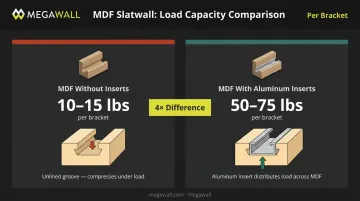
Accessories designed for reinforced panels may fit loosely on unreinforced MDF, where groove clearance tends to be less precise. Under load, a loose fit becomes a safety problem — particularly in high-traffic environments where customers pull merchandise off hooks regularly.
Megawall's steel and aluminum panels don't use separate inserts. The grooves are integral to the metal construction itself, which means the groove profile stays consistent over time regardless of how many times accessories are swapped in and out.
Standard vs. Proprietary Slatwall Systems
Not all slatwall systems accept the same accessories — and choosing the wrong type can lock you into a single supplier for the life of your installation.
Standard (universal) slatwall uses common groove dimensions so any accessory labeled "standard slatwall compatible" will typically fit. Hundreds of hooks, shelves, baskets, and specialty fixtures from dozens of suppliers are interchangeable across these panels.
Proprietary systems use custom groove profiles or non-standard spacing that only accepts the manufacturer's own accessories. You're locked into that supplier's product catalog — and their pricing.
The practical risk: if a proprietary accessory line gets discontinued, redesigned, or repriced, you're out of options. With a universal-compatible system, your sourcing options are unrestricted.
Megawall's steel and aluminum slatwall panels are designed to work with standard slatwall accessories, giving retailers the freedom to source hooks, shelves, and specialty fixtures from the broader market.
Megawall also manufactures its own heavy-duty shelf brackets (in 12", 14", 16", and 18" lengths) and shelves in multiple configurations for retailers who prefer a fully integrated solution.
One compatibility trap worth knowing: wall track systems used in some residential shelving applications look similar to slatwall but use a completely different groove profile. Standard slatwall accessories will not fit these systems. If you're expanding an existing installation or sourcing from an unfamiliar supplier, confirm that the panel is retail slatwall — not a residential track system — before ordering accessories.
Before committing to a large installation, ask your panel supplier in writing whether the system uses standard groove dimensions or a proprietary design.
How Slatwall Material Affects Accessory Fit and Load Capacity
All three primary retail slatwall materials — MDF, aluminum, and steel — accept standard accessories. What differs is how much weight the panel-accessory connection can safely carry, and how the groove holds up over time.
MDF Slatwall
MDF is the most common retail slatwall material. It's affordable, widely available, and works well for lightweight merchandise like apparel, packaged goods, or decorative items.
The limitations are real, though:
- Without inserts: 10–15 lbs per bracket. Fine for light product categories, not appropriate for anything heavier.
- With aluminum inserts: 50–75 lbs per bracket depending on projection and bracket spacing.
- Groove degradation: MDF grooves widen with repeated accessory removal and reinstallation over time, gradually loosening the fit. This matters most for stores that do frequent seasonal resets.
- Moisture sensitivity: MDF is more vulnerable to humidity and physical impact than metal alternatives.
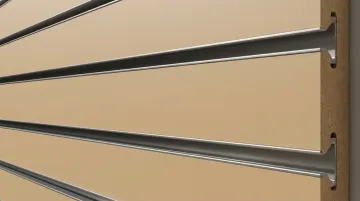
MDF with inserts performs meaningfully better and handles moderate-weight merchandise. For stores with heavy products or frequent reconfiguration, the material itself becomes the limiting factor.
Aluminum and Steel Slatwall
Aluminum slatwall handles environments where appearance and durability both matter. Megawall's aluminum panels are extruded with grooves built directly into the material, so the groove geometry stays accurate through years of reconfiguration — no degradation over time.
Key specs for Megawall aluminum slatwall:
- Groove spacing: 1" to 3" on center, depending on merchandising density
- Recycled content: Over 50% recycled aluminum; LEED-certified
- Groove stability: Extruded profile holds dimensional accuracy regardless of reconfiguration frequency
Steel slatwall is the right call for heavy merchandise categories. Megawall's steel panels hold over 50 lbs per linear foot at the system level, making them practical for hardware, sporting goods, automotive accessories, and similar categories.
Key specs for Megawall steel slatwall:
- Load capacity: 50+ lbs per linear foot (system-level)
- Groove spacing: 3" on center, consistent with industry-standard retail slatwall
- Groove stability: Steel construction keeps dimensions stable through repeated resets
When load capacity and long-term groove integrity are the deciding factors, metal slatwall — aluminum or steel — removes the constraints that MDF eventually imposes.
Types of Slatwall Accessories and Compatibility Considerations
Standard slatwall accessories fall into a few main categories, all designed to slot into horizontal grooves without tools:
- Hooks — straight single hooks, double hooks, and waterfall faceouts for pegged merchandise
- Shelf brackets and shelves — for folded goods, boxed product, or heavier items
- Baskets and bins — for loose, irregular, or bulk items
- Specialty fixtures — garment bars, sign holders, literature displays, cap racks, shoe shelves
Category labeling like "standard slatwall compatible" generally signals an accessory is designed for common groove profiles — but groove spacing varies by manufacturer, ranging from 1-inch to 3-inch on-center. Confirming the spec before ordering prevents mismatches that look identical in a product photo.
Compatibility red flags to check before ordering:
- Double-slot fixtures span two grooves for extra load stability — verify your panel's groove spacing matches before purchasing
- Overseas or discount accessories may have slight backplate variances that cause a loose fit or accelerated groove wear over time
- Unverified bulk orders are a common source of costly returns — order one sample and test it physically before committing to quantity
How to Verify Accessory Compatibility Before Purchasing
Follow this sequence before committing to any new accessory for an existing installation:
- Pull the panel spec sheet — confirm groove spacing (inches on center) and whether the panel uses standard or proprietary groove dimensions
- Identify insert type — aluminum, steel, or none affects both load capacity and groove tolerance
- Compare backing dimensions — the accessory's backplate width and depth should match your groove profile within acceptable tolerance
- Order a sample first. Physical testing beats any spec comparison when evaluating a new supplier or accessory type
- Keep a panel record on file — document manufacturer, groove spacing, material, and insert type so any team member can verify compatibility independently
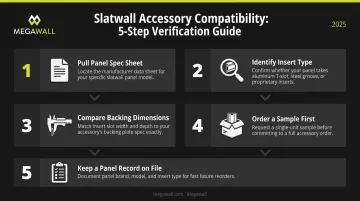
That last point pays off during seasonal resets. When a store manager needs replacement hooks on short notice, documented panel specs let anyone on the team make the right call — no back-and-forth, no incompatible orders.
Frequently Asked Questions
Are slatwall accessories interchangeable?
Most standard slatwall accessories are interchangeable across panels with matching groove dimensions. Compatibility isn't guaranteed across all systems — proprietary groove profiles, non-standard spacing, and different insert configurations can prevent accessories from fitting correctly. Always verify groove specs before sourcing.
What are the different types of slatwall accessories?
Common categories include:
- Hooks (single, double, and specialty styles)
- Shelf brackets and shelves
- Baskets and bins
- Garment bars and sign holders
- Specialty fixtures like literature displays and cap racks
All slot into the panel's horizontal grooves and can be repositioned without tools.
What is standard slatwall groove spacing?
Marlite's installation documentation confirms 3 inches on center as the most widely used retail slatwall spacing. Accessories labeled "standard slatwall compatible" are generally designed for this interval. Some manufacturers also offer 6-inch O/C panels, and specialty systems like Megawall's aluminum line offer spacings as tight as 1 inch.
Can metal slatwall accessories be used on MDF panels?
The accessory material — metal or plastic — doesn't determine compatibility. What matters is whether the backing dimensions match the groove profile. Metal accessories work fine on MDF panels as long as the groove specs align, but users should stay within the panel's weight capacity limits, which are significantly lower for MDF without inserts.
How do I know if an accessory will fit my slatwall panel?
Check the panel manufacturer's spec sheet for groove spacing and depth, then compare with the accessory's backing dimensions. Acme Display's product documentation is one example of how panel specs are typically listed. When in doubt, test a sample unit before placing a bulk order.
What are metal inserts in slatwall and why do they matter for accessory compatibility?
Metal inserts are aluminum or steel channels embedded in MDF panel grooves during manufacturing. They reinforce the slot, increase weight capacity per bracket from 10–15 lbs to 50–75 lbs, and help the groove maintain its dimensions over time — keeping accessory fit consistent throughout the installation's lifespan.